


Welcome to another edition of Earth Observation Essentials, the free biweekly newsletter from TerraWatch covering key highlights from the EO market along with exclusive insights and analysis.
If you would like a more detailed, comprehensive market briefing with exclusive analysis, delivered every week, become a Pro subscriber, or a Premium subscriber, for more deep dives on EO markets, technologies and applications.
📈 EO Market Highlights
Major developments in EO
🤝 Vantor has announced a strategic partnership with Windward, a maritime intelligence firm to offer an automated system that continuously detects and tracks maritime activity at global scale, using high-resolution satellite imagery.
🛰️ The future Earth science missions of NASA - EAGLE and FALCON - will have explicit roles for the commercial EO sector and also include exploration objectives with links to Moon or Mars-related instruments.
The risk: Earth science is surviving politically by attaching itself to exploration - instruments designed for vegetation monitoring on Earth are being pitched as lunar resource identifiers. That is clever politics, but it means instrument design gets optimised for dual-use convenience rather than scientific precision. If that foundational layer degrades because instruments are designed for the Moon first and Earth second, everyone downstream feels it.
🇪🇺 ESA and the European Defence Agency signed an agreement to jointly identify strategic and technological gaps in Europe’s EO capabilities and develop a long-term roadmap in support of security and defence.
🇨🇳 The Economist published an analysis of how Chinese satellites have enabled Iran’s war effort by providing high-resolution imagery, especially at a time when US-based imagery has faced restricted access over the Middle East.
- This piece also includes a few quotes from me, discussing how Chinese commercial EO satellites rival the US in spatial, spectral and temporal resolution as well as how future-proof they are due to the integration of edge computing and laser communication terminals.
In the TerraWatch Pro newsletter this week, I analysed the US–China commercial EO race, comparing the number of very-high-resolution, high-resolution, medium-resolution satellites, hyperspectral, thermal and SAR satellites of both countries.
Upgrade to a Pro subscription for just $75 per year to check out the analysis and receive weekly briefings.
💡 Insight Bytes
A quick dose of analysis from TerraWatch
What Planet's Imagery Restrictions Mean For The EO Sector
Bloomberg published a detailed piece this week on how the US government requested satellite imagery providers "voluntarily implement an indefinite withhold" of imagery across a broad swath of the Middle East. It is worth reading in full, but what it reveals goes beyond Planet's situation. It is the defense paradox essay I wrote about in January, no longer theoretical.
Why Planet Got Targeted
Planet built the most open commercial model in the EO industry: daily global coverage, open API and data accessible to anyone willing to pay. That openness is precisely what attracted commercial customers, and it is also precisely what made Planet the target.
Vantor and BlackSky, which have always tightly controlled access and derive roughly half their revenue from US defense, told Bloomberg they received no such request. They didn't need one as their architectures were already built around controlled distribution. The defense-first companies are actually protected from this specific risk.
My essay in January warned that defense dependency prevents commercial scale. This is the inverse: commercial openness creates a vulnerability that defense-first architectures don't have. The more you optimise for open commercial access, the more exposed you are when the government decides that openness is a liability.
The Downstream Impact
The Bloomberg piece documents the breadth of who's affected: commodity traders, maritime intelligence firms, energy firms, human rights investigators, open-source intelligence researchers and more. That range tells you how deeply Planet's open model had penetrated non-government use cases (credit to them) and how much a single restriction can undo. Every one of those users is now looking for alternatives and it might be non-US EO companies.
Planet's commercial revenue share already dropped from 45% to 18% over four years. Now the same government relationships that dominate its revenue base might be actively degrading the commercial business that remains.
The Shift Towards Non-US Providers
Here is the uncomfortable part: restricting US commercial imagery doesn't remove the imagery from the market, it just redirects who supplies it. European satellites still collect over the Middle East and Chinese commercial operators are clearly still imaging the region.
The users who lost access to Planet aren't going dark, they are going elsewhere: Airbus and potentially Chinese providers. The information the original restriction was designed to control ends up available anyway, but just through providers US has no leverage over. That is the definition of a policy that costs more than it achieves.
Pricing Sovereign Risk
The structural issue isn't that Planet decided to comply with the request from the US government — any US-licensed operator would face the same pressure. The issue is that commercial EO built on US-licensed satellites carries sovereign risk that most commercial buyers never priced in. The realisation that a US-licensed provider can go dark overnight – across an entire region, indefinitely, retroactively — changes how users of EO will start evaluating their decision to acquire satellite imagery or derived products.
European and Asian (especially Chinese) EO providers probably now have a structural advantage. Not because their data is better, but because their governments are less likely to restrict imagery of conflicts they aren't fighting. That advantage didn't exist six months ago. It does now, and it may be a permanent trend.
🔍 Recommended Reads
Interesting links to check out
- Nonprofit CTrees has released aboveground biomass data for every hectare on Earth for the last 26 years, available now as an open dataset.
- Taylor Geospatial, a non-profit, in collaboration with Microsoft AI for Good launched the world's first agricultural field boundary map.
- The UN published an article on what comes after methane emissions are detected using EO and the importance of action.
- If you would like to hear from Meghan Demeter, the manager of the UN methane emissions program, register for the EO Summit – Meghan will be delivering a presentation on the value of EO for methane monitoring.
- A thought provoking opinion piece that discusses how ESA became the power behind the largest EO programme in the world.
- An interesting article that analyses the question, "Can Any Single Satellite Keep Up with the World’s Floods?"
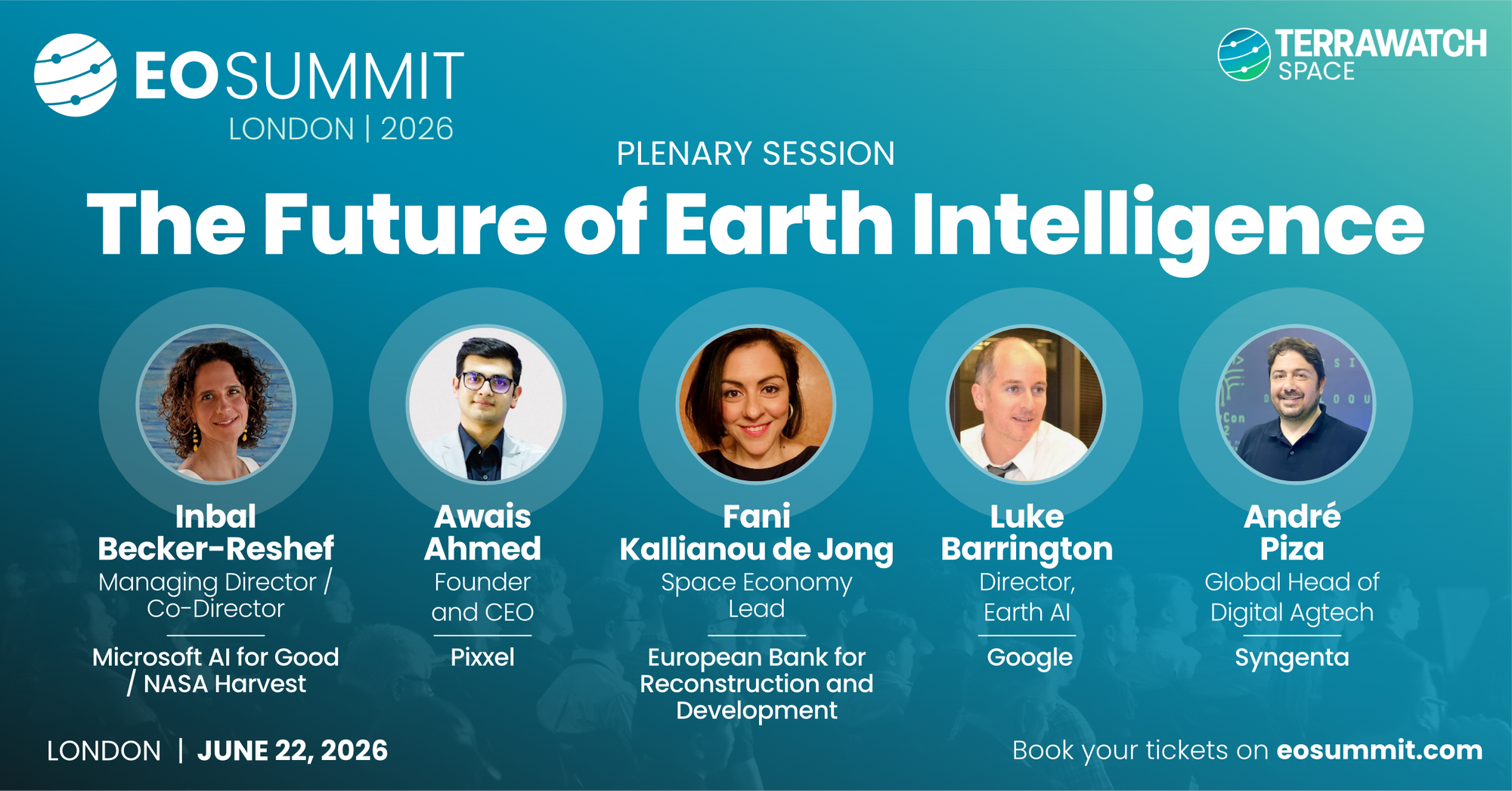
EO Summit: Plenary Session
We are super excited to announce the Plenary Session at EO Summit 2026. We will be hearing from the full EO value chain from data (Pixxel) to AI processing (Google) to user insights (Syngenta) to impact (Microsoft AI for Good and EBRD).
Register now to reserve your place at the only user-focused, application-driven Earth observation conference!
🛰️ Scene from Space
One visual leveraging EO
The Most Marketable Football Club in the World from Space
I am a recovering Manchester United fan. While it is true that they are not the most decorated club in the world anymore, even at their absolute "worst," Manchester United is more valuable and marketable than 99.9% of clubs at their "best." They have a global commercial gravity that doesn't rely on winning trophies every year.
The Athletic published satellite images of every Premier League stadium, courtesy of Planet – and obviously, I had to make this the image of the week as it is the only club that matters (Liverpool, Leeds United and Manchester City fans, you are free to unsubscribe 😄).

Until next time,
Aravind.


