


Welcome to a new, belated edition of Earth Observation Essentials, the free biweekly newsletter from TerraWatch covering key highlights from the EO market along with insights and analysis.
If you would like a more detailed, comprehensive market briefing with exclusive analysis, delivered every week, become a Pro subscriber, or a Premium subscriber, for more deep dives on EO markets, technologies and applications.
PS. This is the last free newsletter edition of the year. So, happy holidays to all!
📈 EO Market Highlights
Major developments in EO
🌍 ESA secured a record budget of €22.1B for the next three years, of which about €3.5B will be allocated for EO. In addition, the Member States offered up to €1.2B to fund a military satellite constellation, part of which will go towards funding EO capabilities – which will include both pooling national EO satellites and building new ones.
💰 Overstory, which offers EO-based vegetation intelligence solutions for the utility industry, raised $43M in Series B funding, which will be used to accelerate development of its AI-based wildfire risk models.
Overstory seems to have escaped both the pilot trap and project trap. They picked one vertical (utilities), solved a specific operational problem (vegetation risk), and integrated directly into how utilities deploy crews. EO is disappearing into grid management workflows.
💰 Iceye raised €150M in new funding, along with €50M in secondary placement, valuing the company at €2.4B, which will be used to accelerate the company’s delivery of sovereign satellite systems and data intelligence services.
🌎 The US will be dismantling the National Center for Atmospheric Research in Colorado, one of the world’s leading Earth science research institutions, as the Environmental Protection Agency erases references to human-caused climate change from its websites.
In the Pro newsletter, over the past few weeks, we covered The Rapid Growth of Commercial SAR Satellites, Europe's Sovereign EO Constellation, Iceye's $2.8B Valuation Explained and more.
Upgrade to a Pro or Premium subscription today for exclusive analysis and insights!
💡 Insight Bytes
A quick dose of analysis from TerraWatch
Five Themes That Defined EO in 2025
This is a short summary of the major themes from EO in 2025. Premium subscribers will get a deeper year-in-review edition later this month.
- When Dual-Use EO Became Mainstream
The language has certainly shifted. Governments and EO companies alike increasingly lead with security and resilience, not rather than environmental monitoring or commercial applications
"Dual-use" moved from euphemism to explicit strategy, visible in how nations frame their EO investments, how satellite firms pitch to customers, and how startups position for funding. The days of leading with insurance, financial services agriculture or climate are fading.
2. When Defense Became the Default Growth Engine Again (Not Commercial)
Hundreds of millions in new defense and intelligence contracts flowed to EO providers this year, from sovereign satellite sales to data subscriptions. Geopolitical tensions are driving demand for persistent surveillance that only satellites can provide.
The commercial scaling story that dominated investor pitch decks has stalled—D&I revenue share is growing while share from commercial verticals is flat or declining. The industry is growing, but not the way the 2020-era funding narrative promised.
3. When The Future of Civilian EO Programmes Came Into Question
The Trump administration proposed cutting NASA Earth Science by 50% and NOAA's research arm by 74%, while pushing to test (especially with Landsat) whether commercial providers can deliver baseline continuity at a fraction of historic costs. ESA's ministerial, on the other hand, delivered a record budget but with a new mandate for security and dual-use, not purely civilian science. Governments around the world are investing in national EO constellations less focused on data-as-a-service, but more on satellite infrastructure.
The question of whether commercial EO companies can take on the responsibilities if public programmes falter is now being stress-tested against the reality that multi-decade calibration, data continuity and open data policies have no commercial business case.
4. When AI for EO Moved from Hype to Reality
Foundation models went from papers to production. Major releases from Google, IBM-ESA, and others made geospatial embeddings and multi-modal models available at planetary scale (with varying degrees of openness and access. But operational adoption hasn't kept pace: models still struggle outside the regions they were trained on, and the embeddings from different providers aren't interoperable.
GeoAI capabilities remain confined to research tasks or one-off projects rather than fully operational workflows. In other words, the technology seems to work, the question is no longer whether AI can deliver for EO, but how fast adoption scales.
5. When Climate & Environmental EO Lost Traction
The demand case for climate and environmental EO weakened on multiple fronts. In the US, the administration moved to defund climate observation missions and withdrew from climate commitments. In Europe, the regulations expected to drive EO-based monitoring solutions (deforestation, corporate sustainability reporting and climate transition plans) were delayed, weakened, or stripped out entirely. The voluntary carbon market—still going through an integrity reset—did not provide an alternative demand signal at scale.
Companies that built capacity for climate and environmental monitoring now face a market where the regulatory pull has weakened and voluntary demand hasn't materialised to fill the gap.
Last few days to upgrade to Pro at $49/year and Premium at $299/year. From January 1, the prices will increase to Pro at $99/year and Premium at $499/year.
Hiring: Operations Lead
I am hiring a full-time Operations Lead (contractor) to support TerraWatch across our upcoming live course, newsletter ops, and events, with an expected start date in mid-January.
🔍 Recommended Reads
Interesting links to check out
- The Geospatial Tech Radar from Element84 that summarises the state of tools, standards, techniques and datasets.
- This paper that analyses the subsidence level in Indian cities using interferometric SAR analysis from Sentinel-1 data (shows that the city I grew up in is sinking quickly).
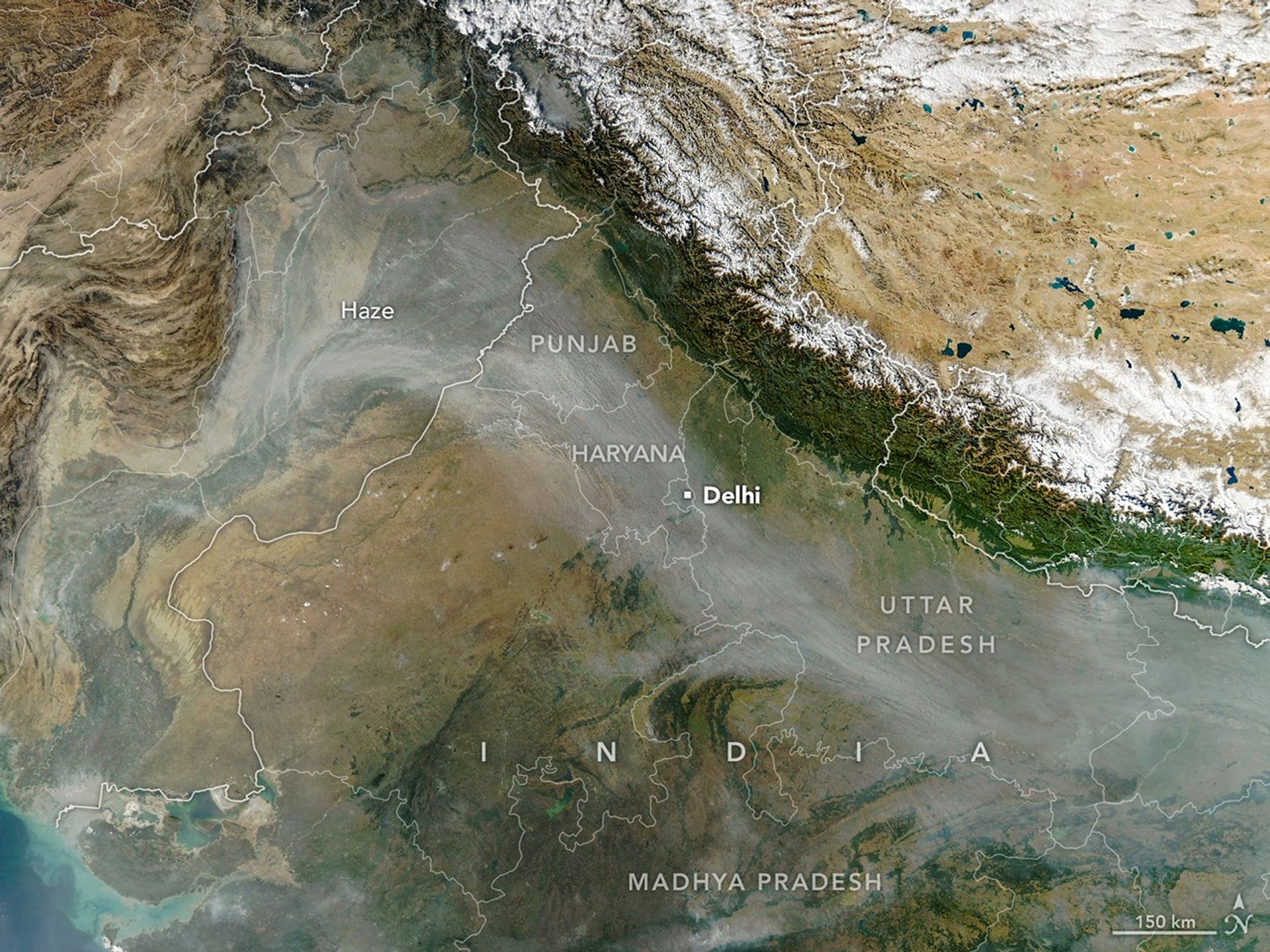
- This article from NASA showing how farmers are changing the time they are burning crop stubble likely to avoid detection by satellites passing overhead.
🛰️ Scene from Space
One visual leveraging EO
Landfill methane monitoring
Landfill sites account for over 10% of human-caused methane emissions. To detect, attribute, and verify methane leaks, measurements from landfills, ground surveys, aircraft measurements, and satellites need to be combined.
In addition, data from Sentinel-5P that provides a regional methane picture needs to be fused with data from higher-resolution satellites like those from GHGSat.
This image below from ESA shows a landfill site near Madrid showing emissions of methane, captured by GHGSat.

Until next time,
Aravind.


