


Welcome to another edition of Earth Observation Essentials, the free biweekly newsletter from TerraWatch covering key highlights from the EO market along with exclusive insights and analysis.
If you would like a more detailed, comprehensive market briefing with exclusive analysis, delivered every week, become a Pro subscriber, or a Premium subscriber, for more deep dives on EO markets, technologies and applications.
📈 EO Market Highlights
Major developments in EO
⚙️ NVIDIA announced dedicated space computing hardware for onboard satellite processing, orbital data centres, and ground-based imagery analysis, making it the first major chip company to build a full product line specifically for the space and EO market. When NVIDIA builds for a market, the rest of the supply chain follows. You can safely say onboard AI compute just moved from niche to commodity.
🛰️ Satellogic announced its new constellation of EO satellites named Merlin which is designed for daily remapping of the planet at one-meter resolution with ten spectral bands and equipped with onboard processing.
But resolution is only half the story. Edge computing is already standard on electro-optical constellations, potentially spreading to hyperspectral, with thermal and SAR next. The satellite that just collects and downlinks is losing its commercial case as the margin is moving to processed intelligence delivered from orbit.
🤝 UK-based market intelligence provider Energy Aspects agreed to acquire French satellite-based energy and environmental analytics firm Kayrros for an undisclosed amount, enabling them to offer a differentiated product offering to navigate volatile global energy markets.
In the Pro newsletter, we covered ICEYE's Path to €1B in Revenues and Why NVIDIA's Space Entry Matters for EO. Upgrade today for more insights!
💡 Insight Bytes
A quick dose of analysis from TerraWatch
Planet's Declining Commercial Revenues
When Planet went public through a SPAC transaction in 2021, the company promised an explosion in uptake of EO and, therefore, corresponding revenues from the commercial sector for non-governmental use cases. Planet forecasted that its revenue share from the commercial segment will grow from 54% of total revenue in 2021 to 68% by 2026.
However, as it often does, the reality has proved to be far different: Planet reported its revenues for 2025 last week and it turns out that the share for the commercial segment actually decreased from 45% in 2021 to just 18% in 2026.
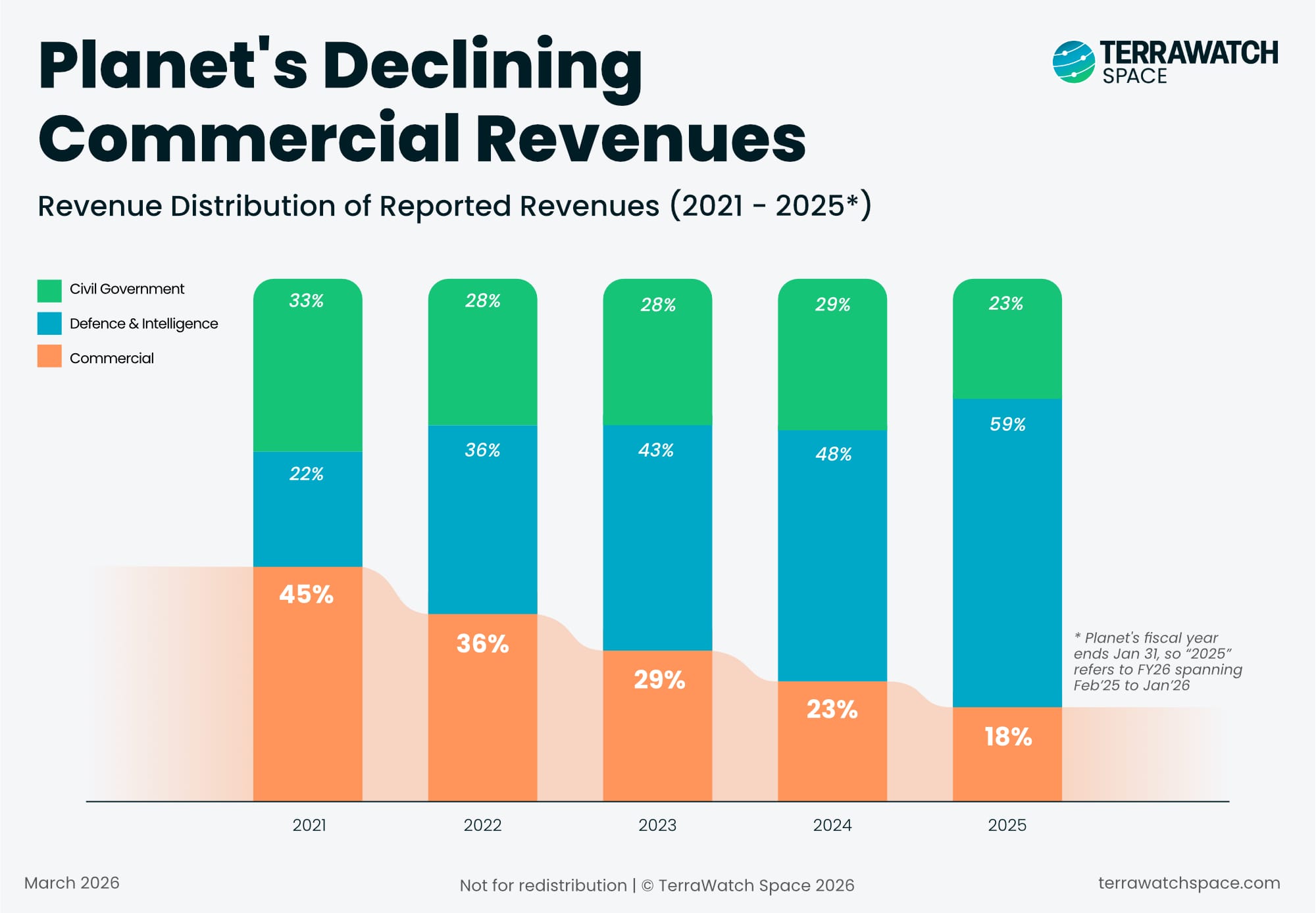
The start of war in Ukraine in 2022 and the rise of investments in sovereign EO constellations globally since then have meant that short-to-medium term growth opportunities in the government segment continue to be a priority for Planet (along with other EO companies), while the elusive growth in the commercial segment is pushed to the long-term bucket.
Although, as I note in my recent essay, this might be a classic case of the defense paradox. Building capabilities for defence customers and assuming they will translate to commercial markets has been the EO industry's recurring bet — and historically, the capabilities, pricing, and delivery models that work for government buyers are precisely what doesn't work for commercial ones.
With a Pro subscription, every Monday, you will receive an exclusive market briefing with new insights on EO, the context behind announcements and an in-depth coverage of satellite data & applications.
EO Summit 2026: Call for Speakers
Are you a large enterprise using Earth observation operationally? We are looking for a few speakers for EO Summit 2026 in London on June 22.
We are specifically looking for large enterprises from insurance, finance, energy, utilities, agriculture, and environment sectors that are already integrating satellite data in their day-to-day operations.
Our thematic sessions include designing parametric insurance products, assessing physical climate risk, tracking GHG emissions, monitoring assets & infrastructure, improving crop intelligence, and monitoring nature & biodiversity.
Submit your interest here through this form (takes 2 mins).

🔍 Recommended Reads
Interesting links to check out
- The latest edition of the State of the Global Climate report by the World Meteorological Organization.
- This article that discusses a new method to fuse time series of images from different optical satellites.
- This piece that explains how a satellite that was meant to monitor ice was able to detect a geomagnetic storm.
🛰️ Scene from Space
One visual leveraging EO
World's Worst Methane Emissions
Methane emissions, which are responsible for roughly 30% of global warming today, have become increasingly more visible thanks to satellites.
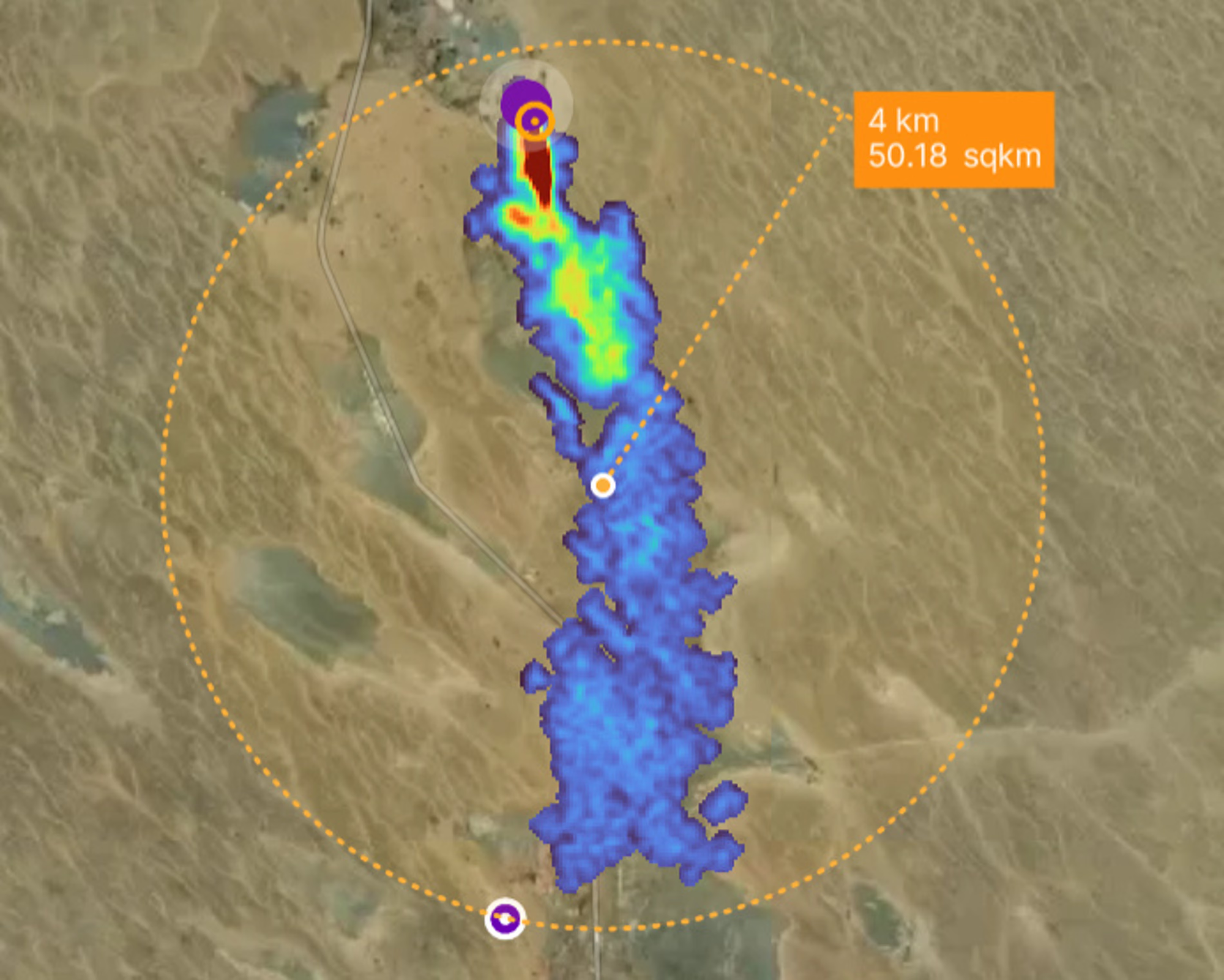
The image below, reported by The Guardian, shows a methane plume in Esenguly, Turkmenistan, with an estimated leakage rate of 18 tonnes/hour – an equivalent of roughly 3.3 million average passenger cars.
Leveraging data from Planet Labs’ Tanager-1 satellite (part of the Carbon Mapper consortium) along with NASA’s EMIT instrument on the International Space Station, researchers of the Stop Methane project found 4,400 significant plumes in 2025.
Until next time,
Aravind.


