


Welcome to another edition of Earth Observation Essentials, the free biweekly newsletter from TerraWatch covering key highlights from the EO market along with exclusive insights and analysis.
If you would like a more detailed, comprehensive market briefing with exclusive analysis, delivered every week, become a Pro subscriber, or a Premium subscriber, for more deep dives on EO markets, technologies and applications.
📈 EO Market Highlights
Major developments in EO
💰 Telespazio Ibérica, the Spanish subsidiary of the Italian firm Telespazio, has been awarded a €20M contract to develop an EO constellation for the Canary Islands, aimed at environmental and emergency management.
As countries look to reduce long-term dependence on external providers, settling for a later launch seems acceptable as long as there is local economic value generated and long-term strategic wins.
💰 Israeli startup Remondo raised $20M with a goal of offering high-resolution (30 cm imagery) at low price - with plans to build, operate, and launch each satellite for $2M or less.
🏭 Environmental Defense Fund, the funders of MethaneSAT satellite, which failed recently in orbit, released data gathered during the satellite’s year of operation showing that emissions from the oil and gas industry consistently and significantly exceed figures reported in widely cited inventories.
In the Pro newsletter, we covered The Growth of Hyperspectral Satellites and The Structural Mismatch of the EO Industry.
Upgrade today for more insights!
💡 Insight Bytes
A quick dose of analysis from TerraWatch
The Edge Computing Pipeline: What Actually Happens Onboard the Satellite
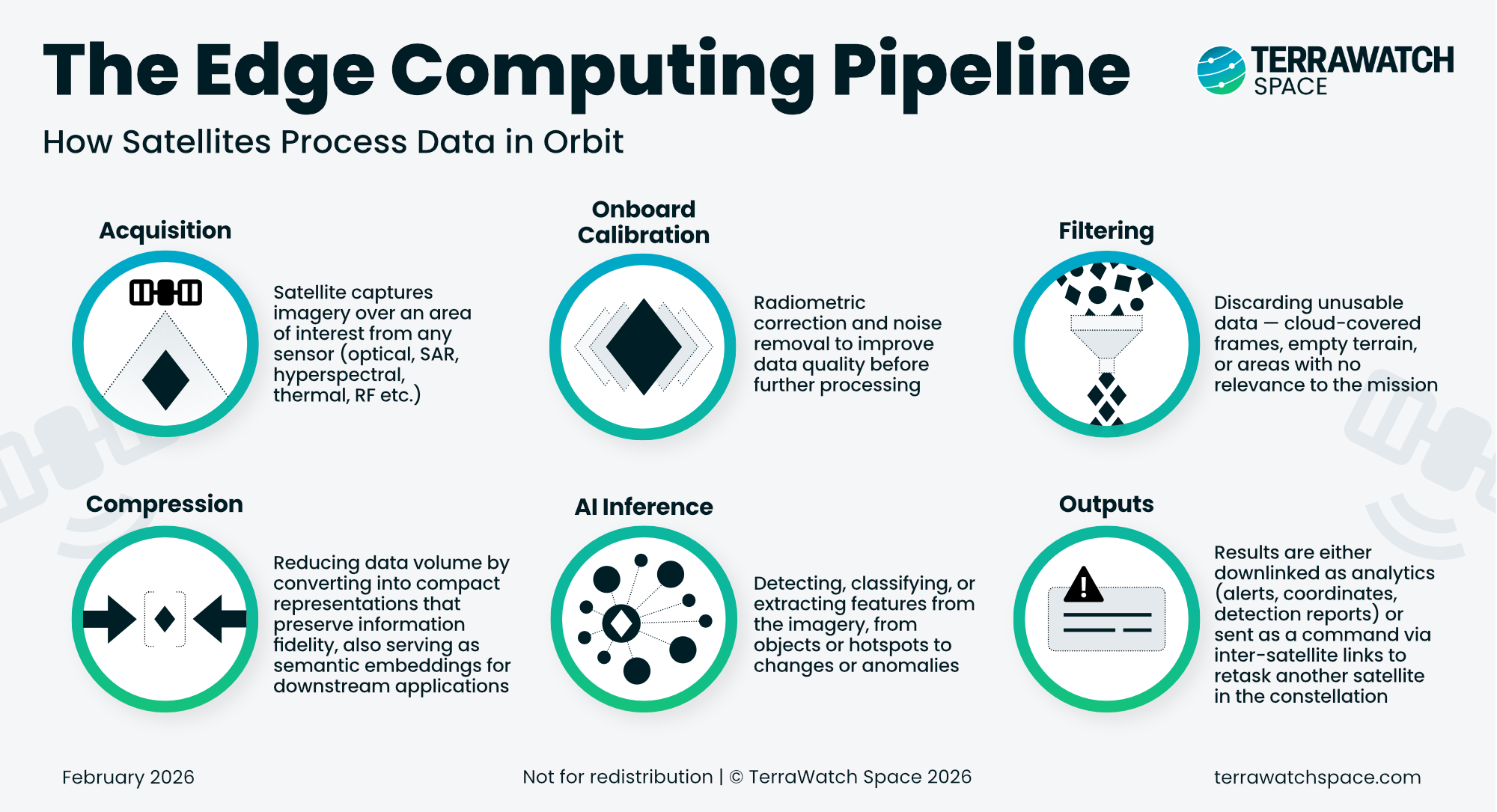
"Edge computing" or "onboard processing" can mean very different things depending on the mission. It helps to break the process down into its constituent steps, before we discuss the types of edge use case categories and the variety of applications.
Acquisition
The satellite captures imagery over an area of interest with a remote sensing instrument: optical, SAR, hyperspectral, thermal, RF or something else. This step is no different from any conventional EO mission. What happens next is where edge computing begins.
Onboard Calibration
Radiometric correction, noise removal, basic quality adjustment. This step doesn't reduce data volume significantly, but it matters more than most people appreciate. If calibration is done poorly (or inconsistently) onboard, the resulting output may not integrate cleanly with ground-processed data downstream. This is a point we will return to in the adoption section, because it is one of the underappreciated barriers to scaling edge computing.
Filtering
This is where the first significant data reduction happens. Cloud masking, discarding empty terrain, removing frames with no relevance to the tasked mission. A large portion of what the sensor captures is not useful and filtering removes it before any further processing takes place.
Compression
Reducing data volume before downlink. This can range from conventional compression to AI-driven approaches where a neural network learns to encode imagery into much smaller representations while preserving the information that matters. The most advanced versions can shrink data volume by orders of magnitude. More interestingly, the compressed representation itself can double as an embedding, a format that downstream AI models can use directly for analytics like classification or change detection without needing to decompress the image first.
AI Inference
Detection, classification, feature extraction and so on that actually contributes to the value generated from satellite data – vessels identified, hotspots flagged or changes detected. Essentially, this is where data transforms from imagery into information.
Output
What comes out of the pipeline and where it goes depends on the mission. But this is where the edge computing process branches into fundamentally different paths, each with different implications for how data reaches the ground and what it looks like when it gets there.
This is where the design choices diverge and where the strategic decisions begin. There are three fundamentally different ways to implement edge computing on a satellite. Each produces a different output, serves different customers, carries different trade-offs, and implies a different business model. Choosing between them, or combining them, is the architectural decision that will define the next generation of EO systems.
Buy the full report on "State of Edge Computing for EO" for $249 which includes:
- the implementation pathways of edge computing,
- the various use cases of onboard processing,
- the edge computing commercial landscape ecosystem,
- the competing bets between edge processing and high-throughput optical downlinks,
- the state of adoption of edge computing, and,
- impact of AI and orbital data centres.
EO Summit 2026: Announcing the First Round of Sponsors
I am excited to announce the first group of sponsors for EO Summit 2026 in London coming up on June 22.
I am delighted to welcome several repeat sponsors and some new sponsors – very grateful for the continued commitment and support, without whom this event wouldn't be possible.
More sponsorship options are available – click here for more information.
Early bird ticket registration is open – click here for details.

🔍 Recommended Reads
Interesting links to check out
- This article that shows how the SWOT mission (a NASA-CNES collaboration) enables a consistent way to monitor the world's rivers.
- This paper arguing that sea level rise is much higher than assumed in most coastal hazard assessments due to vertical errors up to several metres.
- This piece on Nature from a group of climate experts calling for an authoritative and up to date assessment of risks of climate change.
🛰️ Scene from Space
One visual leveraging EO
The Melting of the World's Biggest Iceberg
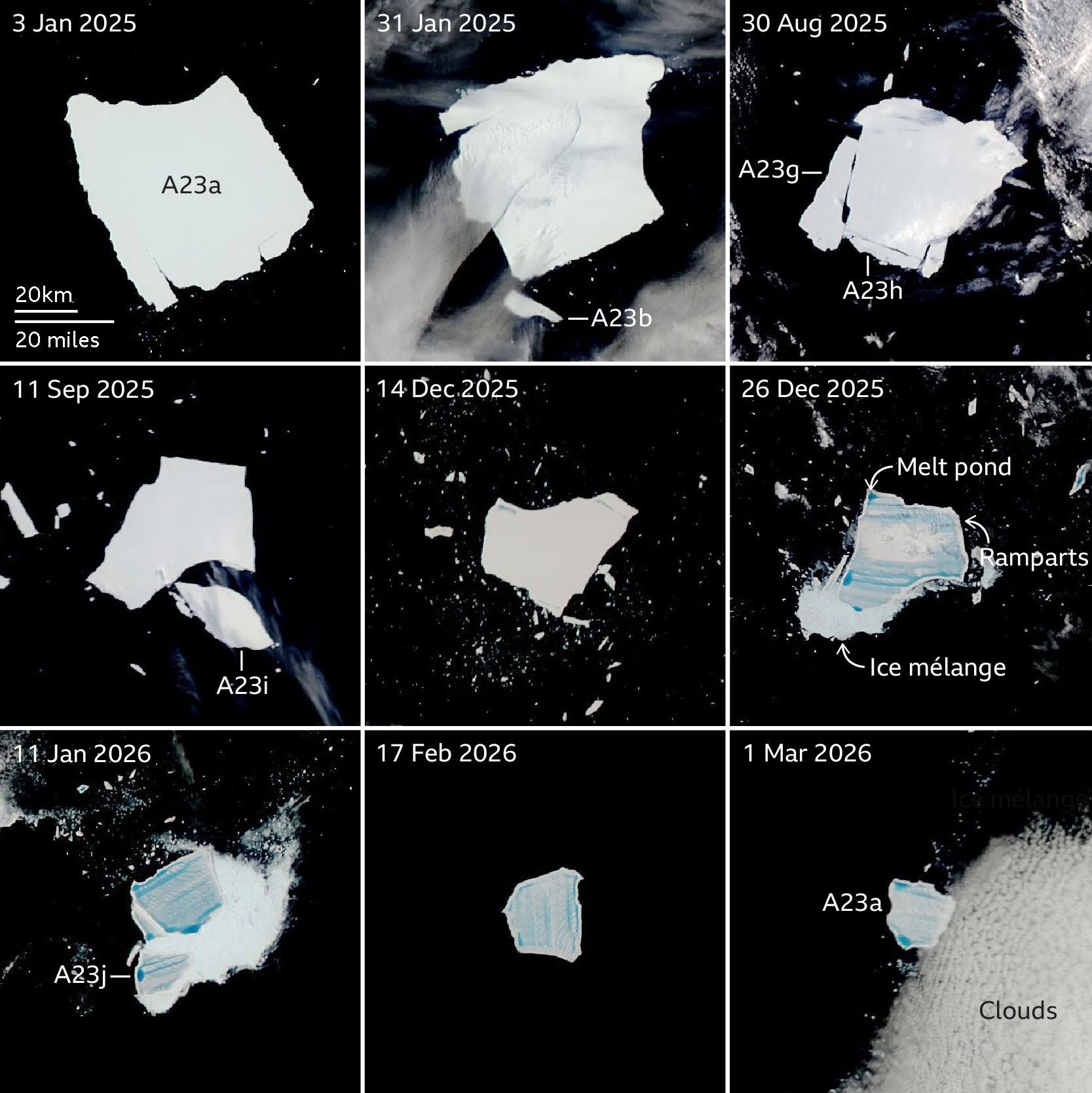
A23a, widely thought to be one of the oldest icebergs in the world today, was also the world's biggest until recently. Satellite imagery captured the disintegration of A23a over the past year and its rapid melting has fascinated scientists.
While iceberg melting is a natural phenomenon and not necessarily the result of climate change, parts of Antarctica are now shedding icebergs faster than the ice can be replaced. Analysing the evolution of A23a can also provide clues about how other parts of Antarctica might respond as the climate changes.
Until next time,
Aravind.


