


Welcome to a new edition of ‘Last Week in Earth Observation’, containing a summary of major developments in EO from the last week and some exclusive analysis and insights from TerraWatch.
If this was forwarded, subscribe for free to get your copy every week. Already a free subscriber? Then, become a paid subscriber and get exclusive EO insights.
Four Curated Things
Major developments in EO from the past week
1. Contractual Stuff: Funding, Contracts and Deals 💰
Contracts
- Spire signed a contract with HANCOM InSpace to provide two additional EO satellites through its space-as-a-service offering;
- Planet announced a $20M agreement to provide hyperspectral data for Carbon Mapper’s greenhouse gas monitoring campaign, from 2026 to 2030;
- EO-based infrastructure monitoring solution provider Asterra and utility firm Suez announced a new contract for water and wastewater monitoring;
Earnings
- Planet reported $58.9M in revenues for Q4 2023, which totalled up to $220.7M for the year, a 15% year-over-year growth;
- EO instrument provider Satlantis reported €17.8M in revenues for 2023, representing a 55% growth.
2. Strategic Stuff: Partnerships and Announcements 📈
Partnerships
- ICEYE is partnering with WWF Finland and the global Arctic Programme to protect whale migration routes in the Arctic region.
3. Interesting Stuff: More News 🗞️
Methane emissions in the US, observed from aerial surveys by Carbon Mapper, were found to be much higher than those officially reported;
China continues to add to its fleet of secretive meteorological satellites with the launch of Yunhai-3 satellites, believed to be equipped with radio occultation sensors;
Related: A deep dive on weather from space by TerraWatch;
New research has found forest regeneration projects generating carbon credits for big polluters are not actually achieving the results they claim.
4. Click-Worthy Stuff: Check These Out 🔗
- The EO4Energy workshop that will take place in Houston, Texas in a few weeks, where I will be delivering the opening keynote;
- This piece (and paper) that discusses how the melting of polar ice might be affecting global timekeeping;
- This article that talks about the TIROS 1 mission, the first weather satellite, which launched on April 1, 1960, and revolutionised weather forecasting.
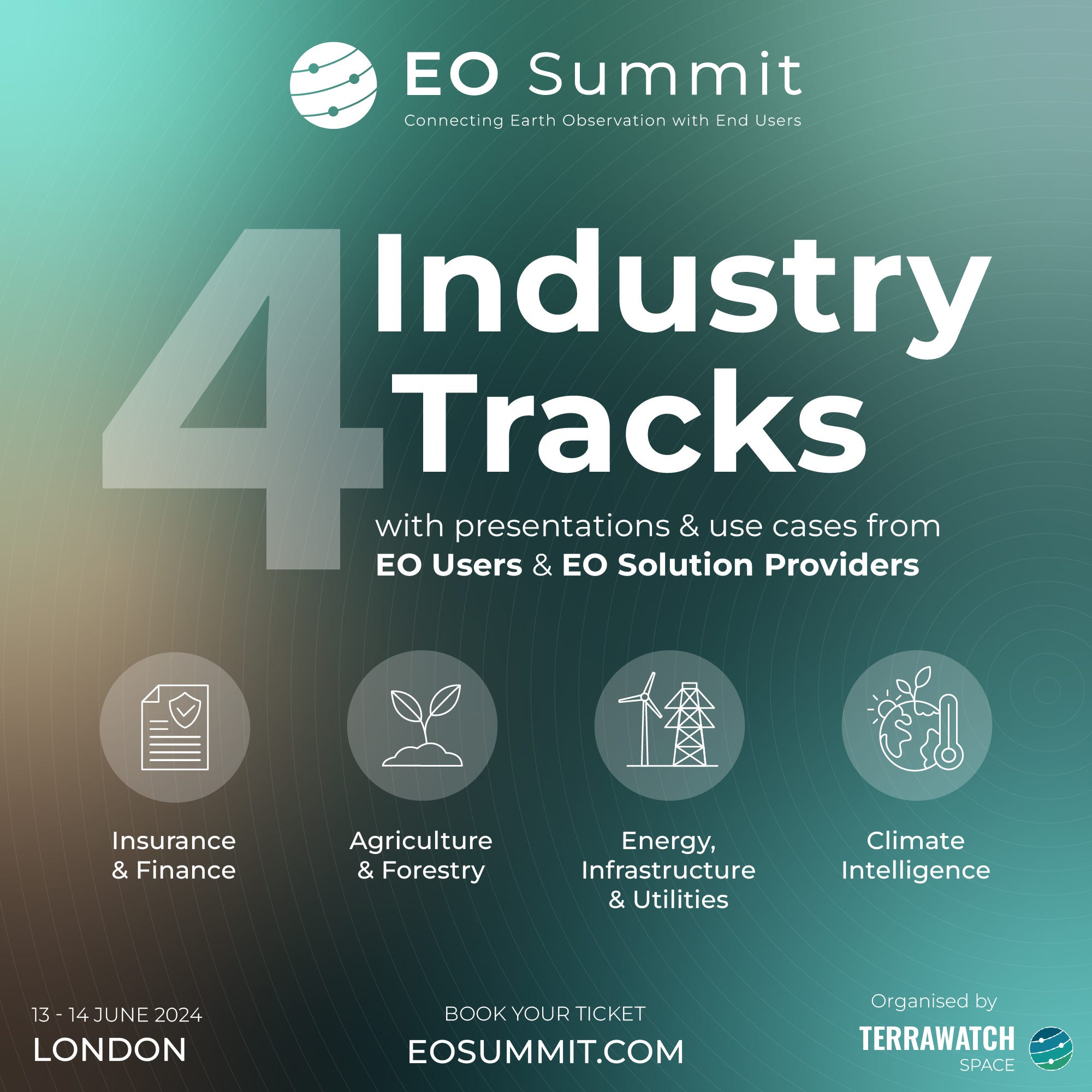
EO Summit: 4 Industry Tracks
Each track will have presentations and panel discussions with the users of Earth observation on use cases, the state of adoption and challenges in using EO along with pitches and case studies from EO companies.
Why organise this way? To have a structured way to discuss the different use cases of EO and the state of its adoption in the respective markets.
Learn more and book tickets for EO Summit here: eosummit.com.
Tip: Save €100 and book your tickets for €299 now. Prices go up in 2 weeks 💸
One EO Discussion Point
Exclusive analysis and insights from TerraWatch
5. EO for Climate Adaptation
If you want a primer on EO for climate, check out the deep dive from TerraWatch on the state of EO for climate.
Weather is just the manifestation of climate change and whether we like it or not, we need to invest in solutions that can help us adapt to the changing climate - and guess what, we have some data to show from early warning weather systems that they do work concerning saving lives, but economic losses continue to increase as the global economy continues to grow. We have a lot of work to do to save lives equally around the world and develop solutions that can help anticipate such events and effectively prepare for them.
EO has a crucial role to play in building such adaptation tools and we have already seen them being used - weather forecasting is the most widely used application of EO. “EO for Climate Adaptation” is a complex market to comprehend, as it might seem like several companies are working on the same type of application, at least from their websites - thanks to the usage of buzzwords like intelligence, risk, insights, etc.
I figured there should be a better way to understand this fast-growing, yet important market segment within EO, especially if you are an outsider looking in. So, I came up with four categories of EO Climate Adaptation companies - classified based on Impact and Time frame.
- Impact - Preparedness vs Responsiveness: Is EO applied for building tools to prepare for or respond to the impacts of climate change?
- Timeframe - Short Term vs Long Term: Is EO used to develop solutions that would be used in the next few days/weeks or the next few years/decades?
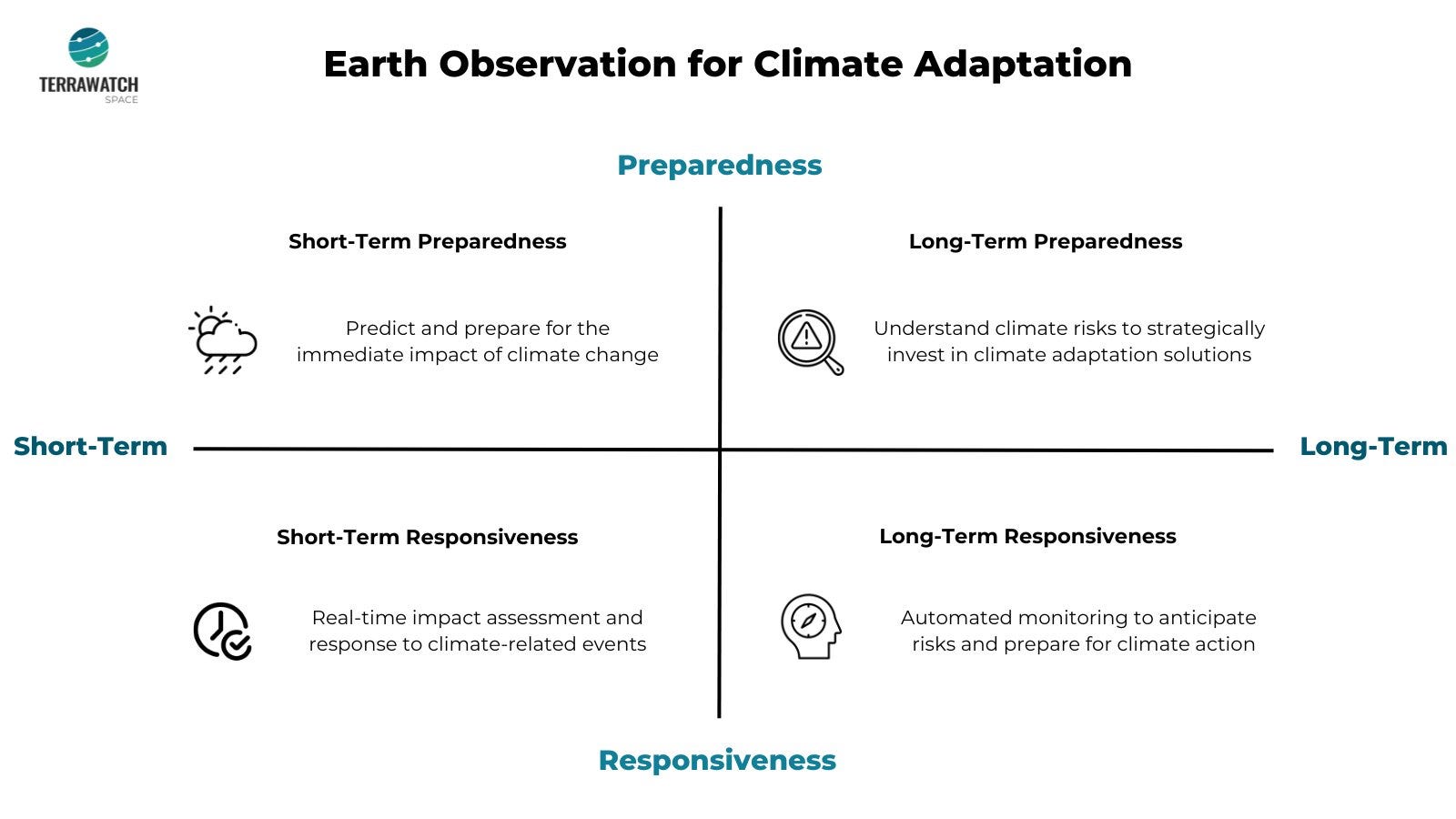
The above framework provided me with four categories of companies, as seen from the four quadrants of the figure above:
- Those that work on predicting and preparing for the immediate impact of weather impacting several industries at once —> Short-Term Preparedness
- Those that work on understanding climate risks for assets, infrastructure and people in the not-too-distant future —> Long-Term Preparedness
- Those that provide real-time impact assessment and disaster support to respond to ongoing climate change —> Short-Term Responsiveness
- Those that enable automated monitoring of assets in order to respond efficiently by anticipating risks —> Long-Term Responsiveness
I will leave it to you to categorise and position companies in the EO for climate commercial landscape on the four quadrants - it is a fun exercise to try on companies that you come across that are leveraging EO data to build climate-related solutions. You will be able to quickly see in which category we have too many solutions and in which one, we have too few solutions.
Scene from Space
One visual leveraging EO
6. Popcorn Clouds
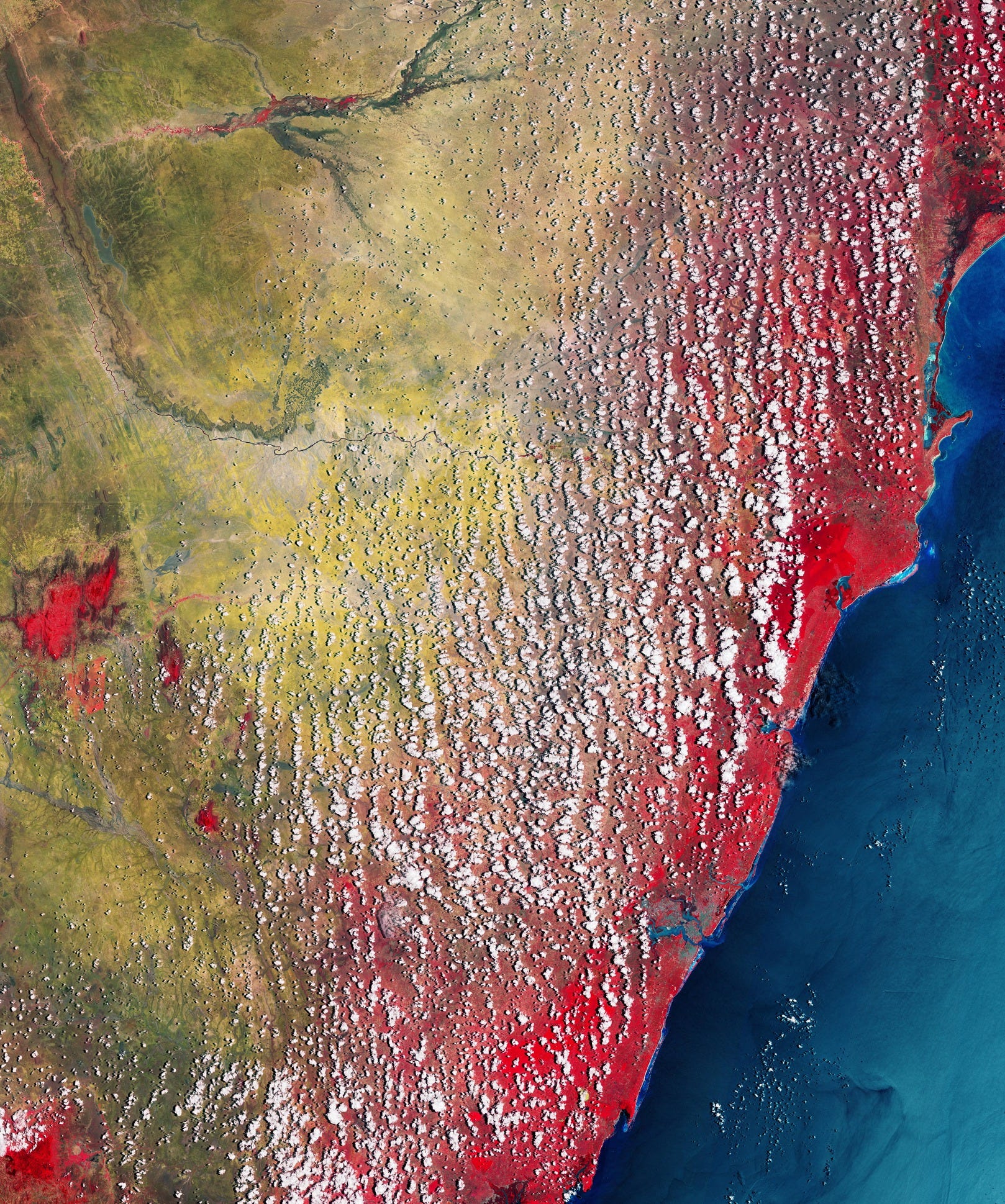
This false-colour satellite image of Southeast Kenya is from the Copernicus Sentinel-2 mission from its near-infrared channel. The red strip of land along the coast denotes heavily vegetated areas, including various natural reserves and parks while the green and yellow areas inland barely have any vegetation.
The clouds seen here are a type of cumulus cloud, more informally called popcorn clouds, resulting from the condensation of water vapour that evaporates from trees and other plants.
Until next time,
Aravind


