


Welcome to a new edition of ‘Last Week in Earth Observation’, containing a summary of major developments in EO from the last week and some exclusive analysis and insights from TerraWatch.
Four Curated Things
Major developments in EO from the past week
1. Contractual Stuff: Funding, Contracts and Deals 💰
Funding
- Indian EO startup SatSure received an equity investment from credit score firm TransUnion, adding to its list of customer-turned-funders;
- Satellite-based radio frequency monitoring EO firm HawkEye 360 secured $40 million in debt financing from Silicon Valley Bank;
- EO-based maritime analytics provider Starboard Maritime Intelligence closed a $3M seed funding round;
Contracts
- EO satellite manufacturer Muon Space won over $60M in new customer contracts for the release of the planned Halo constellation;
- Iceye announced a new contract with the Centers for Disease Control and Prevention providing the agency with flood analysis for the US;
- Thermal infrared data and analytics startup Hydrosat won a NOAA research contract to provide surface temperature data;
M&A
- Descartes Labs, an EO platform provider has acquired Geosite, an EO platform that focuses on providing EO solutions for the insurance sector.
My take: As reported in the TerraWatch analysis, the EO platform segment continues to be overlooked by the venture capital world, receiving less than 3 per cent of overall funding in 2023.
While the dream EO platform company - an all-purpose platform that allows data access, management, processing, fusion and visualisation, across sensors, modalities and mediums - does not exist due to lack of scalable demand for EO, unstructured public funding and availability of customised solution, Geosite was a unique thematic EO platform focused on solving the geospatial problems of specifically the insurance sector.
Descartes’ acquisition of Geosite shows its ambition to be potentially positioned as that elusive, horizontal, multi-vertical EO platform provider.
PS. The long-delayed platform deep dive from TerraWatch will be published for the paid subscribers this Friday. Stay tuned!
2. Strategic Stuff: Partnerships and Announcements 📈
Announcements
- Hyperspectral EO startup Orbital Sidekick released first-light imagery from its new satellites gathering data in 468 spectral bands from 400 to 2,500 nanometers with 8-meter resolution;
- South Korean EO firm SI Imaging Services announced the plan for the SpaceEye-T satellite capable of acquiring imagery at 30 cm resolution.
3. Interesting Stuff: More News 🗞️
- SpaceX launched its first mid-inclination dedicated rideshare mission containing EO satellites from Satellogic, HawkEye 360, Capella Space, iQPS, Satellogic and the South Korean military;
- China launched Yaogan-42, a military satellite thought to be used for both civilian and military reconnaissance applications;
- Russia launched Resurs-P Earth No. 4, a high-resolution land monitoring satellite, adding to the Resurs-P constellation;
- The latest analysis from Global Forest Watch, which predominantly uses data from the Landsat missions, showed that the global tree cover loss continues despite dramatic progress made in Brazil and Colombia.

4. Click-Worthy Stuff: Check These Out 🔗
- This piece that charts, using EO, the journey of a ghost ship which damaged underwater internet lines and impacted millions;
- This article that explains how satellites can measure a forest’s moisture, a technique known as GNSS-Reflectometry;
- This article that discusses how AI can create height maps of urban environments from a single SAR image;
- The SpaceFounders accelerator application call, which is particularly relevant if you are building a space startup in Europe.
EO Summit: Latest Round of Sponsors
I am happy to welcome more exciting EO companies as sponsors for EO Summit: Pixxel, Planet, SatVu, Meissa Planet, GHGSAT, Agtelligence, SatSure
Learn more about the event and book tickets for EO Summit here: eosummit.com!
Tip: Save €100 and book your tickets for €299 now. Prices go up in 1 week! 💸

One EO Discussion Point
Exclusive analysis and insights from TerraWatch
5. State of Weather Forecasting
If you want a primer on the state of weather from space, check out the deep dive from TerraWatch.
The fact that we can forecast the state of the Earth's atmosphere (ergo the weather), through a combination of observations, simulations and models never ceases to blow my mind. The silent revolution in weather forecasting over the past few decades is one of the most underrated stories of the modern era.
The good news is we are in a golden era for both observations and models …
Satellite-based Weather Observations
Not only space agencies such as NOAA, ESA/EUMETSAT, JAXA and ISRO are launching advanced weather satellite systems, but also some commercial companies (see below) are attempting to complement them. This couldn’t have come at a better time as weather and climate are on everybody’s minds - albeit used interchangeably, and sometimes wrongly.
But, to make this work in the long term, and continue filling the weather gaps globally so that everyone can adapt to and prepare for extreme weather events equally, we need successful commercial weather companies that operate in space. And unfortunately, we have not had much success there until recently.
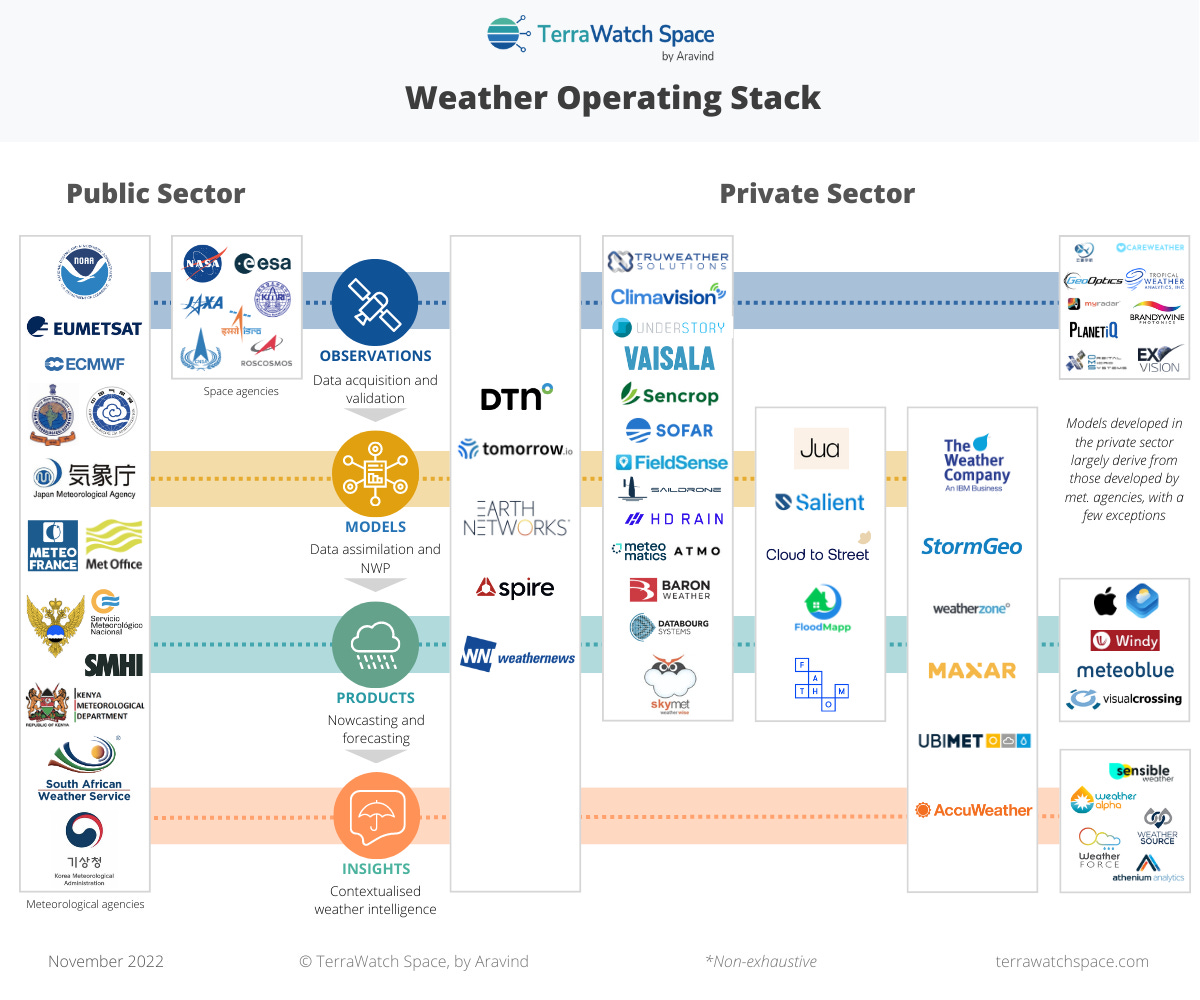
Weather Modelling
The ongoing advancements in computing infrastructure (see NVIDIA) and AI (see Google) are nothing sort of revolutionary. Weather models are expected to advance in their performance rapidly, going up to kilometre-scale resolution and further below, especially as AI capabilities allow simulations and ensemble modelling to be done in a way that was never possible before.
But the bad news is that weather inequality is real.
This paper summarises the current, unequal state of global weather forecasting
- Temperature forecasts are substantially more accurate in high-income countries than in low-income countries. A seven-day-ahead forecast in a high-income country is on average more accurate than a one-day-ahead forecast in a low-income country.
- While forecast accuracy has improved steadily between 1985 and the present, there is a persistent gap between high-income and low-income countries.
- The infrastructure for weather observations is highly unequally distributed across countries, with fewer land-based weather stations and radiosondes in poorer countries.

TLDR; The ongoing advancements in sensors, compute and AI make me optimistic for a future with global weather equality.
If this was forwarded, subscribe for free to get your copy every week. Already a free subscriber? Then, become a paid subscriber and get exclusive EO insights.
Scene from Space
One visual leveraging EO
6. A Decade of Copernicus Sentinel-1
Since its launch in April 2014, the Sentinel-1 satellite part of the EU’s Copernicus programme has been one of the most impactful missions for understanding our planet, our activities on the planet and the relationship between the two. As the only radar satellite in orbit that currently provides data on a free and open basis, over 2.3 petabytes of data from Sentinel-1 is downloaded by users worldwide every month, leading to many economic, environmental and societal impacts.
After Sentinel-1B’s failure, we have been at reduced capacity for Sentinel SAR imagery for over two years. And, the current state of European launch means that the Sentinel-1C and Sentinel-1D satellites, currently sitting in storage, won't be launching until the end of the year.

Until next time,
Aravind


