


Welcome to a new edition of ‘Last Week in Earth Observation’, containing a summary of major developments in EO from last week and some high-level thoughts on the sector that I have come to love.
In this edition: Methane emissions, air quality from space, football and EO, several announcements and partnerships, earning reports and a 7-step strategy to enable sustainable adoption of EO by end-users.
Four Curated Things
Major developments in EO from the past week
1. Contractual Stuff: Funding, Deals and More 💰
- The Canadian Space Agency awarded a contract to EO startup OroraTech specialising in thermal infrared and Spire Global with its space-as-a-service offering to perform preparatory work for a wildfire-monitoring satellite;
- Airbus won a one year long pilot contract from the UK Geospatial Commission to provide public sector from 35 organisations with access to commercial, high resolution satellite EO data;
- BlackSky reported $18.4M in revenues for Q1 2023, a 32% year-over-year (YoY) increase with contracts from government defense agencies;
- Meanwhile, Spire Global reported $24.2M in revenues for the same period, a 34% YoY increase with contracts across its aviation, maritime and data businesses;
- L3Harris won a contract from NOAA valued at $275.2M to continue providing ground services for the GOES-R series of weather satellites;
- NOAA is also setting up plans for the next generation of polar weather satellites following the successful Joint Polar Satellite System, called NEON.
2. Strategic Stuff: Announcements and Partnerships 📈
Here are the partnerships …
- Insurance firm AXA Climate extended its strategic partnership with Planet specifically for the use of one of its Planetary Variables - Soil Water Content;
- UEFA signs a partnership with ESA to evaluate the use of satellite imagery for crowd management and pitch mapping use cases;
- SAR satellite company Iceye signed an agreement with insurance solution firm Global Parametrics to provide flood data for parametric insurance;
- Japanese startup Warpspace, which is building an optical inter-satellite data relay service is partnering with Australian EO startup LatConnect 60;
- SAR satellite firm Capella Space will supply imagery to LiveEO, a German EO startup for integrating into its disaster response solutions;
And here are some announcements …
Weather intelligence firm Tomorrow.io announced the launch of a new solution that provides global precipitation forecast with a better (48-61%) accuracy for precipitation intensity compared to publicly-available products ;
EO non-profit Radiant Earth (previously Radiant Earth Foundation) has announced the launch of two initiatives:
Source Cooperative, a data publishing utility to make it trivially easy for geospatial data providers to make data products available on the Internet;
Cloud-Native Geospatial Foundation to increase adoption of highly efficient modern data sharing best practices;
LiveEO announced the launch of a solution to verify compliance of a supply chain with the EU’s Deforestation Regulation (for selected commodities);
Esper Satellite Imagery will launch their hyperspectral sensor later this year on Akula Tech’s satellite platform.
3. Interesting Stuff: More News 🗞️
- Using data from French EO startup Kayrros, the Guardian reported that the methane emissions from the two main fossil fuel fields of Turkmenistan contributed more to global warming in 2022 than the entire carbon emissions of the UK;
- Sticking to methane, the EU could push for a law that would require oil and gas companies in Europe to check their above-ground infrastructure every two-to-four months, and fix methane leaks they discover;
- A satellite from Terran Orbital Corporation, a US-based small satellite manufacturer, has enabled the demonstration of a space-to-ground optical link that successfully transmitted 200 gigabits per second;
- IBM, in partnership with NASA, announced a new geospatial foundation model to convert satellite data into customized maps of natural disasters and other environmental changes that would enable enterprises to identify climate-related risks';
- Consulting firm CGI is working with UK’s Ordnance Survey to develop a develop water pollution predictive tool using satellite data and AI;
- Data from the EU’s Copernicus programme shows that the ongoing wildfires in Alberta, Canada and in Siberia, Russia are worsening air quality and increasing carbon dioxide emissions.

4. Click-Worthy Stuff: Check These Out 🔗
- This piece providing an overview of applications of EO for the financial services sector written by yours truly (!) for EO platform startup SkyFi;
- An interesting paper that shows, with satellite data, how cities with subway systems can reduce CO2 emissions by 50% compared to those that do not;
- How satellites help wineries pick new climate-friendly sites;
- Deriving yearly global above ground biomass maps by combining data from JAXA’s L-band SAR ALOS mission and ESA’s C-band Sentinel-1 mission;
- This edition of Planet’s Snapshots newsletter on using satellite imagery to monitor water pollution (contains some snaps of the elixir of life and showing how we are polluting waterways, lakes, and oceans).
Subscribe for more Earth observation insights!
One Discussion Point
Analysis, thoughts, and insights on developments in EO
5. A 7-Step Strategy To Enable Sustainable Adoption of EO by End-Users
If you read my stuff before, you know what I think about and talk about all the time - what is the most optimal way to get end-users to start integrating EO into their workflow to get their job done, with a objective1 and holistic2 mindset, working towards making EO mainstream. Over the past year, I have worked with dozens of end-user organisations across insurance, financial services, agriculture, forestry, mining sectors, helping them think through how they should approach the use of EO for solving their problems and getting their job done. Through those activities, I have identified the following 7 steps as a means of engagement with end-user organisations and it has become my go-to format for engaging with them. Sharing this with everyone for feedback and reference!
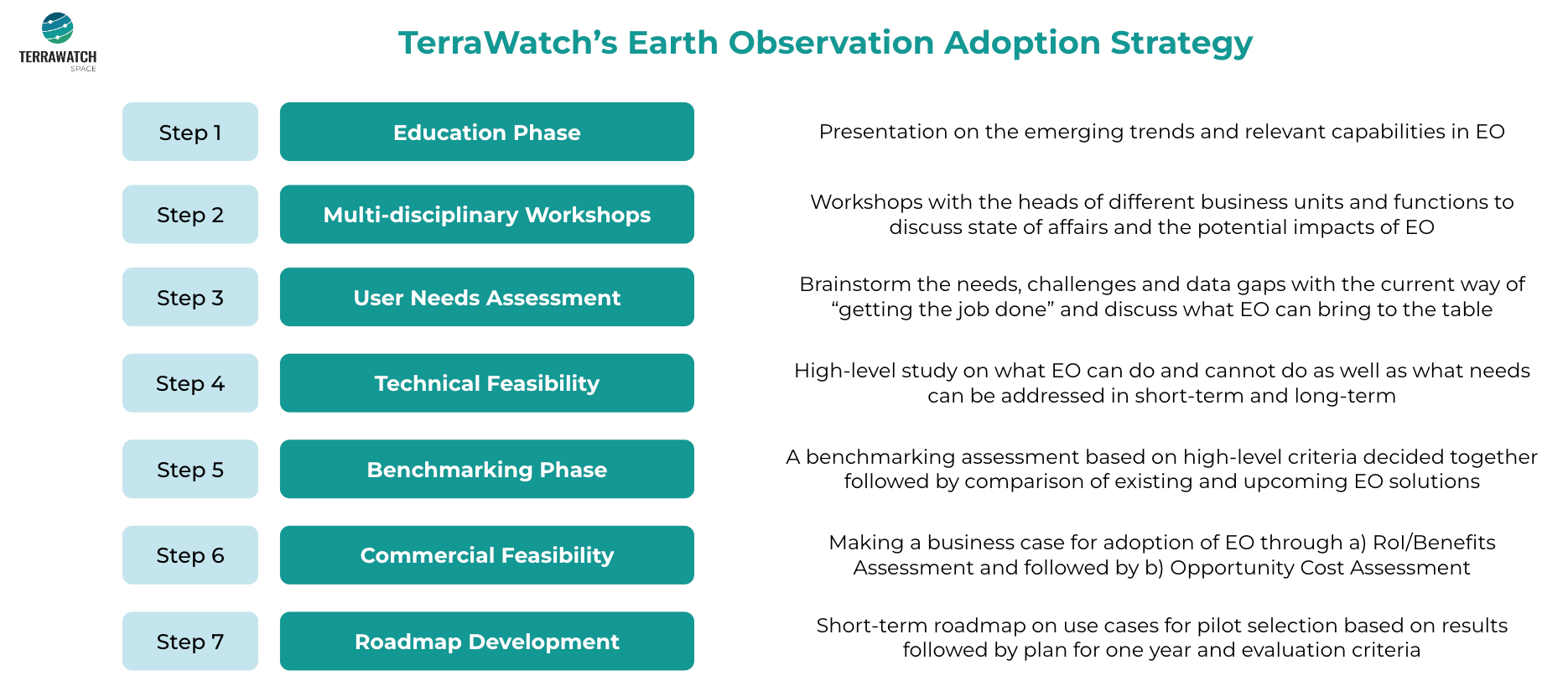
Note that not every organisation needs to go through each of the 7 steps, this is just a comprehensive framework, that I use for my consulting assignments.
- If the organisation is already using EO and just wants to scale up, they could directly go to step 5 and benchmark the various ways to start scaling up.
- If the organisation is already well aware of what EO can do for them and only wants support on validating that, they could start with step 4.
- If the organisations already understand what is EO, but just need support on identifying areas where EO can add value, they could start with step 2.
In any case, this is a work in progress - let me know what you think. Every end-user organisation is different. Each of them has its own problems to solve, varying EO capabilities, different impact priorities, available budgets, and overall KPIs. So, every organisation has a different approach to using EO data and it comes with its own challenges. But one thing is clear:
The more I interact with end-users of EO, the more I see that they care more about the EO-based solution being reliable, trustable and scalable than where the EO data used to build the service comes from, what the sensor is, what the resolution is etc.
One Podcast Episode
From the TerraWatch Space podcast
6. Satellite Imagery in 3D - Use Cases, Potential and Maxar’s Strategy
If you had paid attention to the company over the past few years, going private aside, Maxar has been heavily investing in its 3D market strategy - whether it is the initial partnership and later acquisition of Vricon, the acquisition of AI and software development company Wovenware or the recent partnership with blackshark.ai on digital twins.
So, I had Josh Winer from Maxar on the podcast to discuss Maxar's thinking and the potential of 3D satellite imagery. In this episode, we discuss their strategy, use cases for 3D imagery in industries such as telecom, automotive and gaming, complementary/substitute EO sensors, the differences and similarities of going to market with 3D vs 2D and more. Check it out!
Until next time,
Aravind.
An independent assessment of what EO can do and cannot do, how much does it cost, what are the benefits of using EO for getting the job done and what is the action plan. ↩
A comprehensive evaluation of identifying the ideal remote sensing approach to solve a problem - sometimes it is EO, sometimes it is in-situ sensors, sometimes it is drones and sometimes it is good, old-fashioned way of having a human do the work. ↩


