


Welcome to a new edition of ‘Last Week in Earth Observation’, containing a summary of major developments in EO from last week and some thoughts on the sector that I have come to love.
In this edition: SAR deals, precipitation radars, observing the decline in lake water storage from space, and a framework for understanding EO solutions for climate adaptation
Four Curated Things
Major developments in EO from the past week
1. Contractual Stuff: Funding, Contracts and Deals 💰
A couple of funding announcements from Arlula and Amini …
- Australian startup EO startup Arlula which is building a marketplace for satellite imagery, raised ~$1.5M (AUD 2.2M) in a seed round;
- Amini, a Kenya-based startup raised $2M in a pre-seed funding round to build a data aggregation platform and potentially, a constellation of satellites aimed at closing environmental data gaps in Africa;
And some deals featuring Iceye, Spire, MDA, EarthDaily Analytics etc. …
- Iceye will be providing five SAR satellites to Bayanat, a data analytics company and Yahsat, a satellite communications company, in an effort to build sovereign EO capabilities for the UAE;
- South Korea’s Hanwha Systems and Korea Aerospace Industries were awarded contracts by the country’s Agency for Defense Development to develop SAR satellites by 2027 for the Korean military;
- The European Maritime Safety Agency awarded two-year-long contracts to European Space Imaging and Airbus for the delivery of very high-resolution optical satellite imagery;
- The Canadian Space Agency awarded contracts to three EO companies - Spire Global, MDA and EarthDaily Analytics for taking initial steps towards the implementation of the WildFireSat mission, launching in 2029;
- Spire Global was selected by TrueOcean, a marine data platform to provide 10-day global forecasts of maritime weather;
2. Strategic Stuff: Partnerships and Announcements 📈
Some partnerships …
- SAR analytics platform Ursa Space Systems is partnering with SAR data startup Umbra to bring advanced SAR analytics to the market;
- Australian EO startup Esper, which is launching its first hyperspectral satellite later this year, is partnering with EO marketplace SkyFi;
- EO-based infrastructure monitoring startup, Spottitt is partnering with weather intelligence company Meteomatics to provide weather and climate-related information for critical infrastructure;
- Scepter, which is building an emission monitoring satellite constellation for oil and gas firm, ExxonMobil, is partnering with AWS for developing its multimodal data analytics platform;
- Sustainability consulting firm ERM is collaborating with Planet to leverage its satellite imagery for building sustainability-focused solutions;
- Sidus Space, which offers a space-as-a-service model is partnering with the ground segment as a service startup Leaf Space for ground services;
And some announcements …
- Weather intelligence company Tomorrow.io announced the successful on-orbit operation of its recently launched satellite, which is the first commercial satellite with a weather radar for monitoring precipitation;
- Meanwhile, the Chinese Meteorological Administration released the first 3D rainfall maps from the recently launched Fengyun-3 G satellite, equipped with a precipitation radar, a microwave imager among other instruments;
- Rocket Lab will launch the second pair of TROPICS satellites for NASA, later this week to complete the constellation aimed at monitoring tropical storms;
- A consortium of EO companies led by Planet released one of the largest EO training datasets for machine learning applications, as part of an EU project;
- The World Meteorological Organization has warned of a 98% likelihood that at least one of the next five years, will be the warmest on record, and a 66% likelihood that the annual average global temperature between 2023 and 2027 will be more than 1.5°C above pre-industrial levels for at least one year.
3. Interesting Stuff: More News 🗞️
- Republican lawmakers in the US are pushing for cuts to NASA budget which may impact several EO projects, as outlined in the letter by its Administrator;
- A group of satellite companies from five different countries will work on launching a satellite called COPSAR aimed at atmospheric monitoring;
- France aims to launch a new-generation EO satellite before 2030 for use by its armed forces (in French);
- Satellites are playing a key role in spotting the early signs of the developing El Niño phenomenon which can bring extreme weather to the world, which could cause trillions of dollars of losses globally;
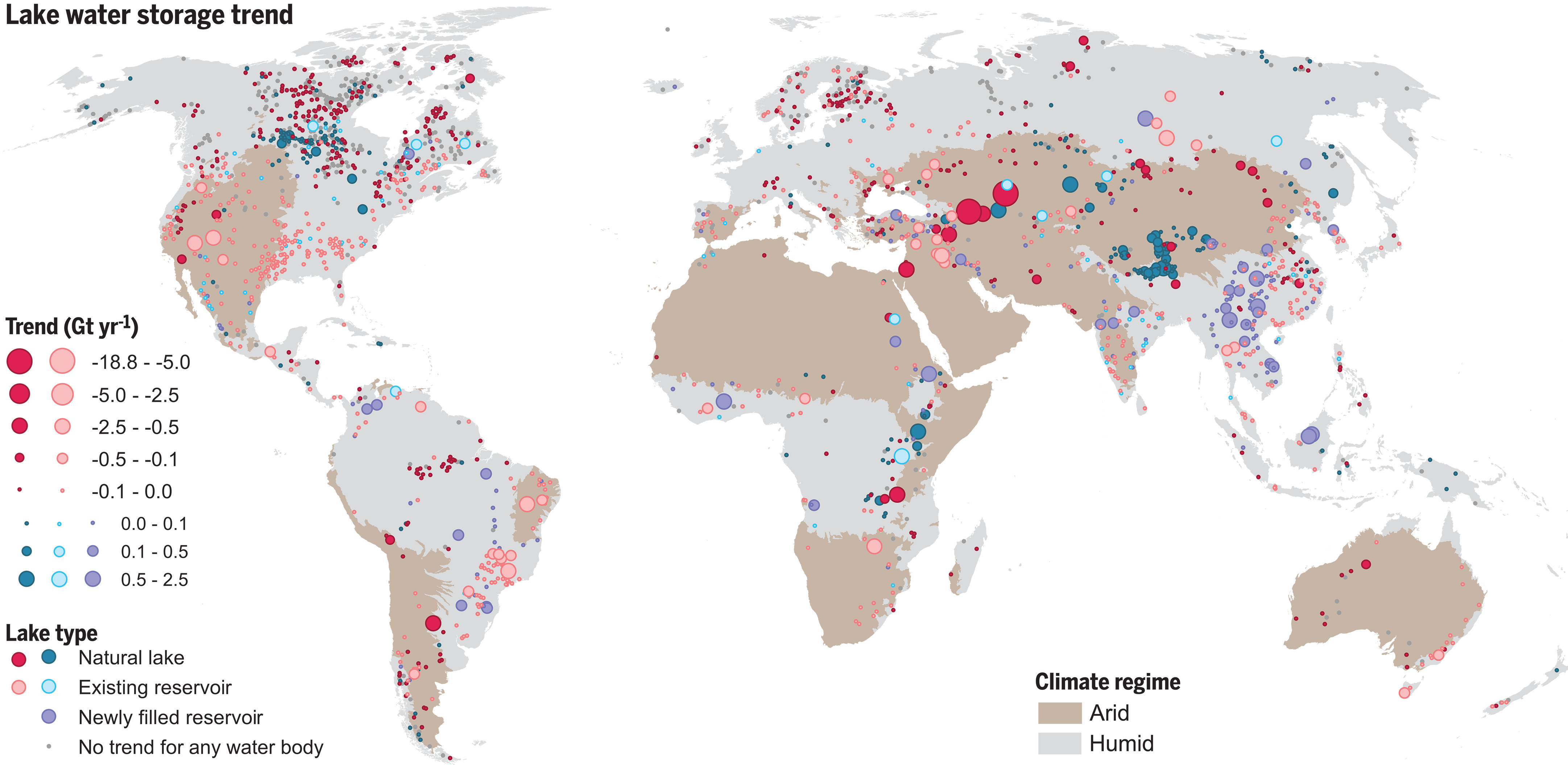
- A recent paper showed, with satellite data, how lakes, which store 87% of Earth’s liquid surface fresh water, have seen widespread decline globally;
4. Click-Worthy Stuff: Check These Out 🔗
- This primer on satellites, orbits and constellations;
- This article on the top 10 myths about satellite imagery from EO platform startup, Astraea;
- This investigative piece that uses satellite AIS data from Spire to track the flight that delivered arms to Russia from South Africa;
- This interesting article that dives deep into how climate change can affect transportation (spoiler: flights are about to get bumpier!);
- This report from PwC/Strategy& on space investment trends in the UK, where I found this fascinating data point: EO is the segment with the highest number of VC deals in the space industry - but, does it get as much attention though?!

Subscribe for more Earth observation insights!
One Discussion Point
Analysis, thoughts, and insights on developments in EO
5. A Framework for Understanding EO Solutions for Climate Adaptation
It is a fact that we have been experiencing some unprecedented weather events around the world - whether it is the recent floods in Italy (which is expected to cost billions of euros in losses), the cyclone in Malawi and Mozambique, which killed over 1,000 people, or the atmospheric flooding events in California earlier in the year. While attributing every single weather event to climate change is not something that can be said with certainty (some of those links being proved - see here and here), something that we need to accept as a society is the need to build climate adaptation solutions.
Weather is really just the manifestation of climate change and whether we like it or not, we need to invest in solutions that can help us adapt to the changing climate - and guess what, we have some data to show from early warning weather systems that they do work with respect to saving lives, but economic losses continue to increase as the global economy continues to grow. We have a lot of work to do to save lives equally around the world and develop solutions that can help anticipate such events and effectively prepare for them.
EO has a crucial role to play in building such adaptation tools and we have already seen them being used - weather forecasting is the most widely used application of EO. “EO for Climate Adaptation” is a complex market to comprehend, as it might seem like several companies are working on the same type of application, at least from their websites - thanks to the usage of buzzwords like intelligence, risk, insights, etc.
I figured there should be a better way to understand this fast-growing, yet important market segment within EO, especially if you are an outsider looking in. So, I came up with four categories of EO Climate Adaptation companies - classified based on Impact and Timeframe.
- Impact - Preparedness vs Responsiveness: Is EO applied for building tools to prepare for or respond to the impacts of climate change?
- Timeframe - Short Term vs Long Term: Is EO used to develop solutions that would be used in the next few days/weeks or in the next few years/decades?
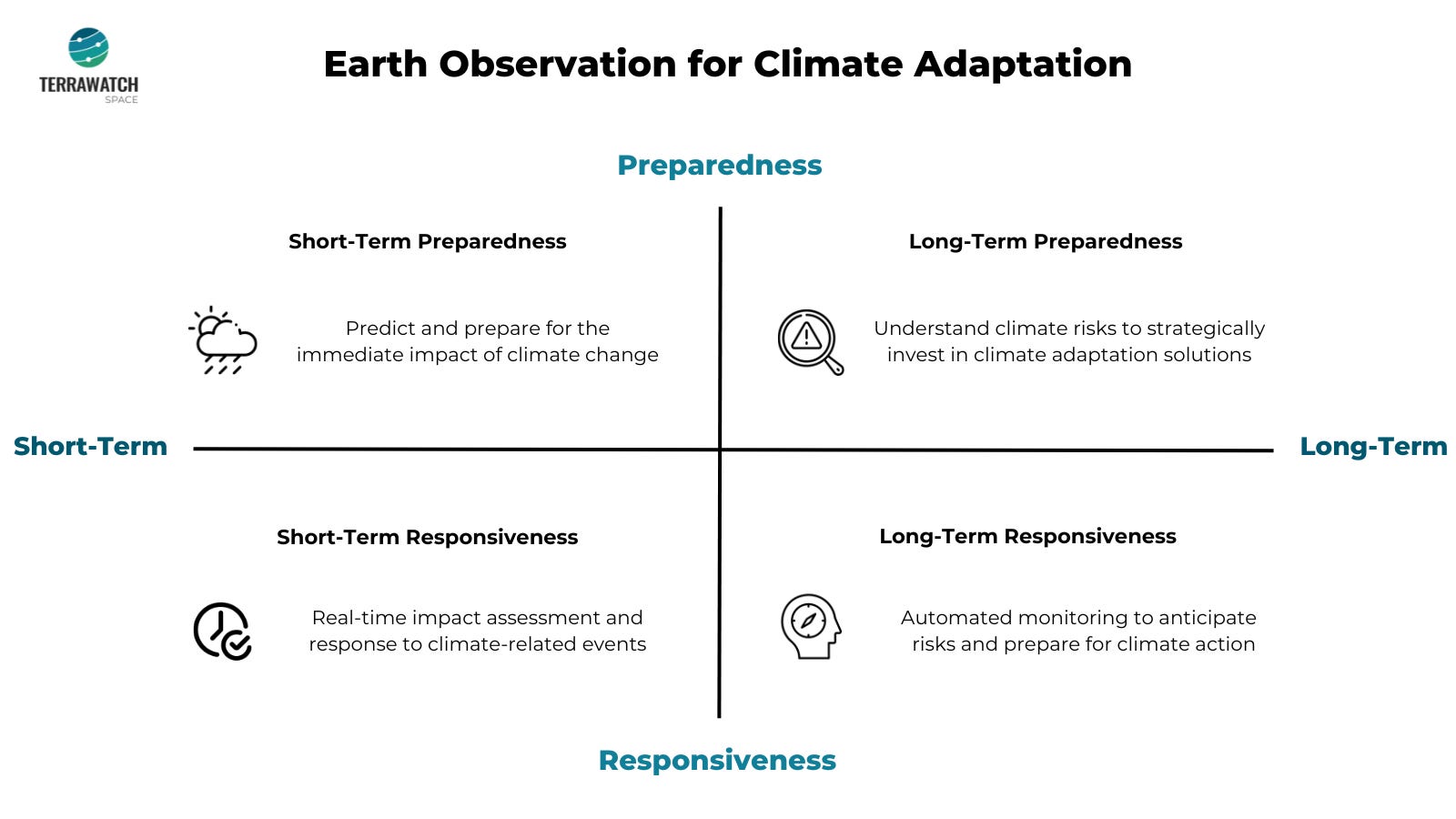
The above framework provided me with four categories of companies, as seen from the four quadrants of the figure above:
- Those that work on predicting and preparing for the immediate impact of weather impacting several industries at once —> Short-Term Preparedness
- Those that work on understanding climate risks for assets, infrastructure and people in the not-too-distant future —> Long-Term Preparedness
- Those that provide real-time impact assessment and disaster support to respond to ongoing climate change —> Short-Term Responsiveness
- Those that enable automated monitoring of assets in order to respond efficiently by anticipating risks —> Long-Term Responsiveness
I will leave it to you to categorise and position companies that you may know of on the four quadrants - it is a fun exercise to try for companies that you hear of that are leveraging EO data to build climate-related solutions. And, if you are like me, you will be able quickly see in which category we have too many solutions and in which one, we have too few solutions.
One Podcast Episode
From the TerraWatch Space podcast
6. L-Band Synthetic Aperture Radar (SAR) Imagery: Commercial Applications & Market Potential
L-Band SAR is unique in its own way, in terms of its availability, usability and potential. So, to discuss this further I spoke to two execs from Asterra, an Israeli startup offering a satellite-based solution for monitoring infrastructure, whether it is for monitoring roads, rails, dams, water utilities and even for mining.
In this episode, we discuss Asterra's strategy, the advantages of L-band SAR, its availability and applications, polarimetric SAR and its use, how Asterra is using SAR for mining applications and more. If you are curious to learn more about the applications of SAR, specifically L-band SAR, this episode might be a good intro.
PS. This week we have two big conferences in EO: the geospatial intelligence-focused GEOINT conference in St.Louis, USA (which I am not attending, but closely tracking) and the climate-focused GLOC in Oslo, Norway (which I am attending and speaking at). All updates from both events in next week’s edition!
Until next time,
Aravind.


