


Welcome to a new edition of ‘Last Week in Earth Observation’, containing a summary of major developments in EO from last week and some exclusive analysis and insights from TerraWatch.
In this edition: Technology-driven strategy vs. problem-driven strategy, coral reefs, state of the climate and some good news on deforestation
Four Curated Things
Major developments in EO from the past week
1. Contractual Stuff: Funding, Contracts and Deals 💰
- Weather intelligence firm Tomorrow.io is expanding its recent Series E funding round by $22M (to the $87M raised in June), including from strategic investors such as the UAE’s Strategic Development Fund;
- Wildfire monitoring EO startup OroraTech, won a contract from the Forestry Corporation of New South Wales, essentially an extension of their current partnership to improve wildfire management in Australia;
- Greenhouse monitoring EO firm GHGSat closed a Series C1 funding round of US$44M, which includes strategic investors such as the Japan Energy Fund and the Government of Québec;
- Planet reported revenues of $53.8M for Q2 2023, with major contracts from institutions such as the UK Rural Payments Agency and the US Space Force';
- Weather forecasting startup Salient Predictions was awarded a grant from NOAA to advance their AI-driven water availability forecasting system, capable of predictions up to 52 weeks ahead.
2. Strategic Stuff: Partnerships and Announcements 📈
SpaceChain, a Singapore-based startup that has integrated blockchain nodes into satellites, unveiled an AI-based platform called I-Sat, an interactive tool to answer questions with Earth observation data;
EO data platform UP42 is teaming up with Israeli EO satellite operator ImageSat International (ISI) to provide access to 30 cm resolution optical imagery from the ISI's EROS NG satellite constellation;
Hyperspectral satellite operator Pixxel is partnering with EO marketplace SkyFi to integrate its hyperspectral data into SkyFi's platform;
American Airlines, through a collaboration with Breakthrough Energy and Google, demonstrated a method to reduce aircraft contrails 1using data from weather satellites (but scaling this might not be an easy task);
The UK Government announced plans to join the Copernicus and Horizon Europe programmes through a bespoke agreement with the EU, putting an end to questions about the future of the world’s largest EO programme;
European Space Imaging (EUSI), a satellite imagery provider is partnering with SAR satellite operator Umbra to offer SAR data to EUSI’s customers;
Wyvern, a hyperspectral imaging startup, has partnered with space infrastructure firm Loft Orbital, securing capacity on a Loft Orbital satellite with a hyperspectral payload.
My take: This is quite an innovative move from both Wyvern and Loft. Instead of the typical "space-as-a-service" model — OroraTech with Spire, EarthDaily with Loft Orbital, GHGSat with Spire etc., —Wyvern is leasing capacity on a Loft Orbital satellite with a hyperspectral payload. Note that this not the first time Wyvern has chose to go with this model - the two payloads that Wyvern operates in orbit have been leased from AAC Clyde Space, another satellite manufacturer.
Recall the many EO upstream satellite business models, which I wrote about a few months ago. Wyvern’s leasing capacity model is certainly one to keep an eye on - after all, it seems like the least capex-intensive and the most flexible of all the options, although reliability could take a hit.
3. Interesting Stuff: More News 🗞️
- EO solution provider GAF and the ESA have started a project to enable long-term preservation and public accessibility to data from Indian EO satellites, IRS-1C and IRS-1D, providing data from the pre-Sentinel era;
- The UN’s Marine Sand Watch, the first-ever global data platform on sand and other sediment extraction in the marine environment, found that about 6 billion tons of sand is extracted annually, impacting marine life;
- Maxar, Copernicus Emergency Management Service and UN Disaster Charter among others activated their open data and mapping programs to support damage assessments in the wake of the earthquake in Morocco.
- The State of the Climate Report a peer-reviewed, international annual review of the world’s climate from more than 570 scientists in over 60 countries, was released which showed that greenhouse gas concentrations, global sea level and ocean heat reached record highs in 2022.

4. Click-Worthy Stuff: Check These Out 🔗
- This deep-dive on edge computing for EO, exclusively for the paid subscribers of the TerraWatch Space newsletter;
- It is conference season again - check out the list of all EO-related events, conferences and workshops remaining in 2023 from around the world;
- The latest edition of the Snapshots newsletter containing some amazing visuals of the coral reefs around the world, and some context on why it is a tipping point for the colourful colonies of invertebrate marine animals.

Subscriber for more Earth observation insights!
One Discussion Point
Analysis, thoughts, and insights on developments in EO
5. Technology-Driven Strategy vs. Problem-Driven Strategy for EO Satellites
We have seen an explosion of EO satellite companies over the past few decades, particularly in the last five years. However, interesingly out of the five dozen EO companies that I track, I have observed that almost all of them follow a technology-driven EO satellite strategy, roughly summarised below.
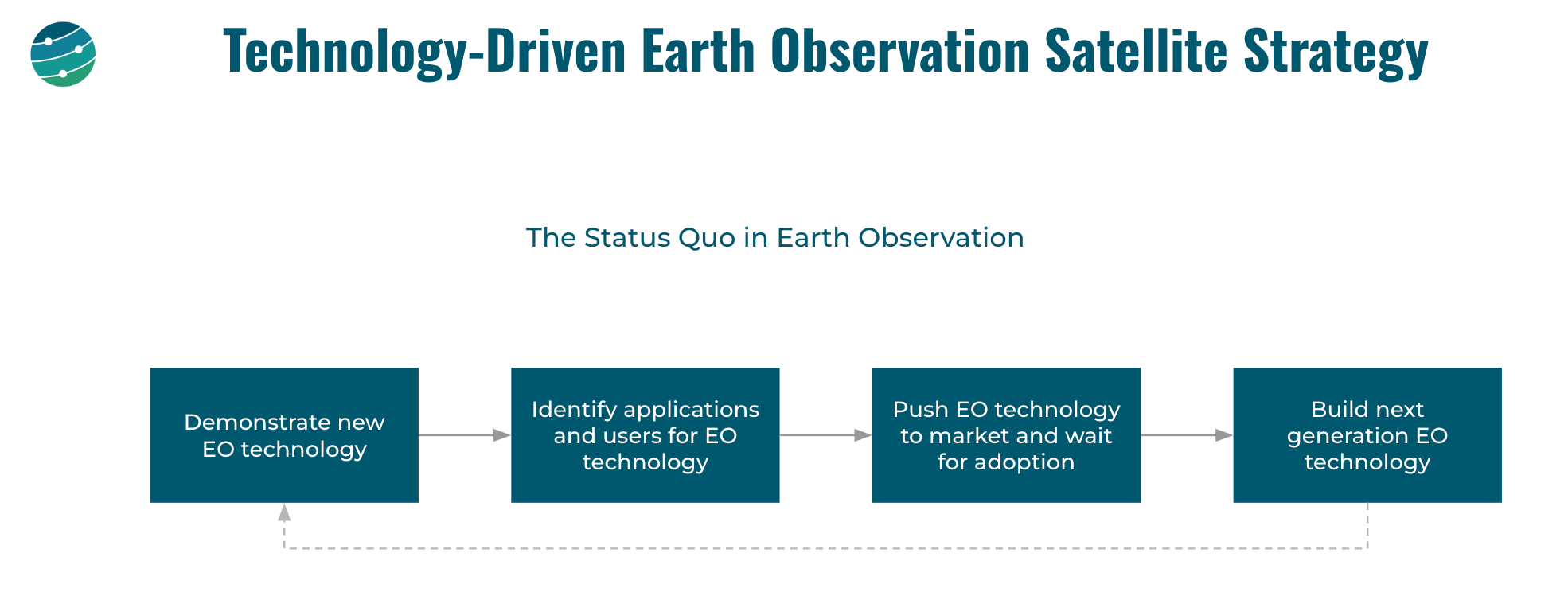
However, in the last couple of years, we have seen the rise of a problem-driven EO satellite strategy, which also fall under the category of backward vertical integration - EO analytics companies transitioning to become an EO satellite firm. This has been largely because those analytics companies have found a problem for which there is no other solution other than launching their own satellites. Tomorrow.io, MyRadar, EarthDaily Analytics, SatSure and EOS Data Analytics belong this new category of companies.

What does this mean?
As much as we need horizontal, multi-purpose EO data companies, we will continue seeing verticalised, use-case-driven EO application companies that want to launch satellites with a purpose.
I am quite certain that this will not stop here - I expect more backward vertical integration in EO i.e. more companies launching satellites purposefully - because they have a business problem to solve as opposed to because they have a technology to demonstrate.
Scene from Space
One visual leveraging EO
6. Some Good News on Amazon Rainforest Deforestation
According to the Brazilian space research agency INPE, the rate of deforestation in Brazil's Amazon rainforest has dropped by 66% this August compared to the same month last year. This analysis, conducted by INPE using EO data, is notable as August has been one of the months when the deforestation rates have been the highest.
Independent analysis has verified this development, and this good news marks the continuation of the positive recent trend in Brazil showing decreasing deforestation. Note that the global deforestation rates still remain worryingly high, according to analysis from the Global Forest Watch.

Until next time,
Aravind.
Airliners can leave behind contrails, or condensation trails, of ice crystals that form artificial clouds around particles in the planes’ exhaust. These clouds trap heat in the Earth’s atmosphere, representing about 35% of the aviation industry’s contribution to global warming. ↩


