


Welcome to this belated edition of ‘Last Week in Earth Observation’, containing a summary of major developments in EO from last week and some exclusive analysis and insights from TerraWatch.
Last week I attended the EUMETSAT conference and the World Satellite Business Week in Paris, so this edition is extra long and contains many announcements and updates from the events.
In this edition: EO for emissions monitoring and mitigation, satellite imagery for chimpanzee habitat conservation and analysing Accenture’s investments in EO.
Four Curated Things
Major developments in EO from the past week
1. Contractual Stuff: Funding, Contracts and Deals 💰
Funding
- Smallsat manufacturer Open Cosmos raised $50M in a Series B round to expand its EO satellite business, from investors including technology consulting firm Accenture (more on this below);
- VIDA, a German EO analytics startup raised €3M to provide physical climate risk information for infrastructure-related investments;
Contracts
- Ball Aerospace was awarded a contract worth $487M to deliver a hyperspectral infrared sounder for NOAA’s GeoXO satellite constellation;
- SAR satellite company Iceye was selected by the Government of Australia to supply flood and bushfire hazard data used for disaster response;
- Spire was selected by Estuaire, an aviation data analytics startup to provide satellite and terrestrial ADS-B data;
Deals
- US defense contractor General Atomics acquired electro-optical sensor supplier EO Vista to expand its weather satellite business.
2. Strategic Stuff: Partnerships and Announcements 📈
Announcements
- UAE-based geospatial solution provider Bayanat is partnering with hyperspectral satellite firm HySpecIQ to enable hyperspectral imaging and analysis capabilities in the country;
- KaleidEO, the subsidiary of Indian EO startup SatSure, has successfully demonstrated on-orbit processing with in-orbit computers from Spiral Blue and imagery from Satellogic (read more on edge computing here);
- EO data distributor SkyFi has unveiled geospatial analytics features on its platform, called SkyFi Insights, as well as the availability of open EO data;
- Ground segment provider KSAT is implementing an integrated satellite tasking, data reception and processing platform for near real-time delivery of ship detection services;
Partnerships
EO data marketplace SkyWatch partnered with Satellogic to have the data available on their platform, while another EO data marketplace UP42 partnered with SAR data provider Umbra;
Esri is integrating its ArcGIS mapping platform with Microsoft Azure Space to enable access to real-time data access and analysis capabilities;
EO satellite provider SATLANTIS is partnering with Dotphoton, a company specialising in building image compression software;
AWS is partnering with the Indian space agency ISRO and its commercial space arm IN-SPACE to support EO-related, cloud-based solutions;
Satellogic has signed an agreement with Skyloom with plans to integrate Skyloom’s optical communications terminal onto Satellogic’s satellites which will reduce data downlink latency.
3. Interesting Stuff: More News 🗞️
- California has unveiled regulations that mandate pollution disclosures, including supply chain greenhouse gas emissions for companies with annual revenues over $1 billion;
- Satellite data has shown that the sea ice surrounding Antarctica is well below any previously recorded winter level, alarming experts;
- Egypt will launch MisrSat-2, a land monitoring satellite, built in partnership with China, later this year;
- Techstars announced the 12 startups joining its Space Accelerator, including EO startups Esper, Little Place Labs and PierSight Space;
- EUMETSAT released preliminary data from the MTG-I1 weather satellite, showing combined data from the imager and the lightning imager;
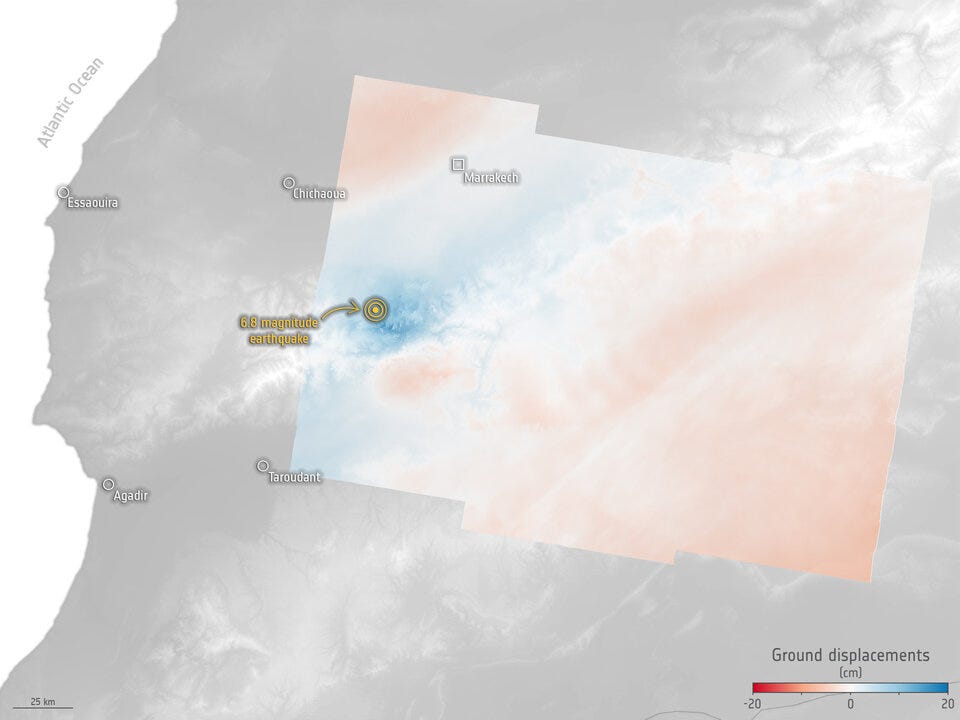
- Data from the Sentinel-1 satellite are being used to analyse how the ground has shifted as a result of the earthquake in Morocco.
4. Click-Worthy Stuff: Check These Out 🔗
- This update to the Planetary Boundaries Framework that used satellite data among several other sources to find that six of the nine boundaries have been breached;
- This paper that proposes an ambitious foundation model for EO;
- This piece that dives deep into the early warning system in Japan, in which satellites play a major role;
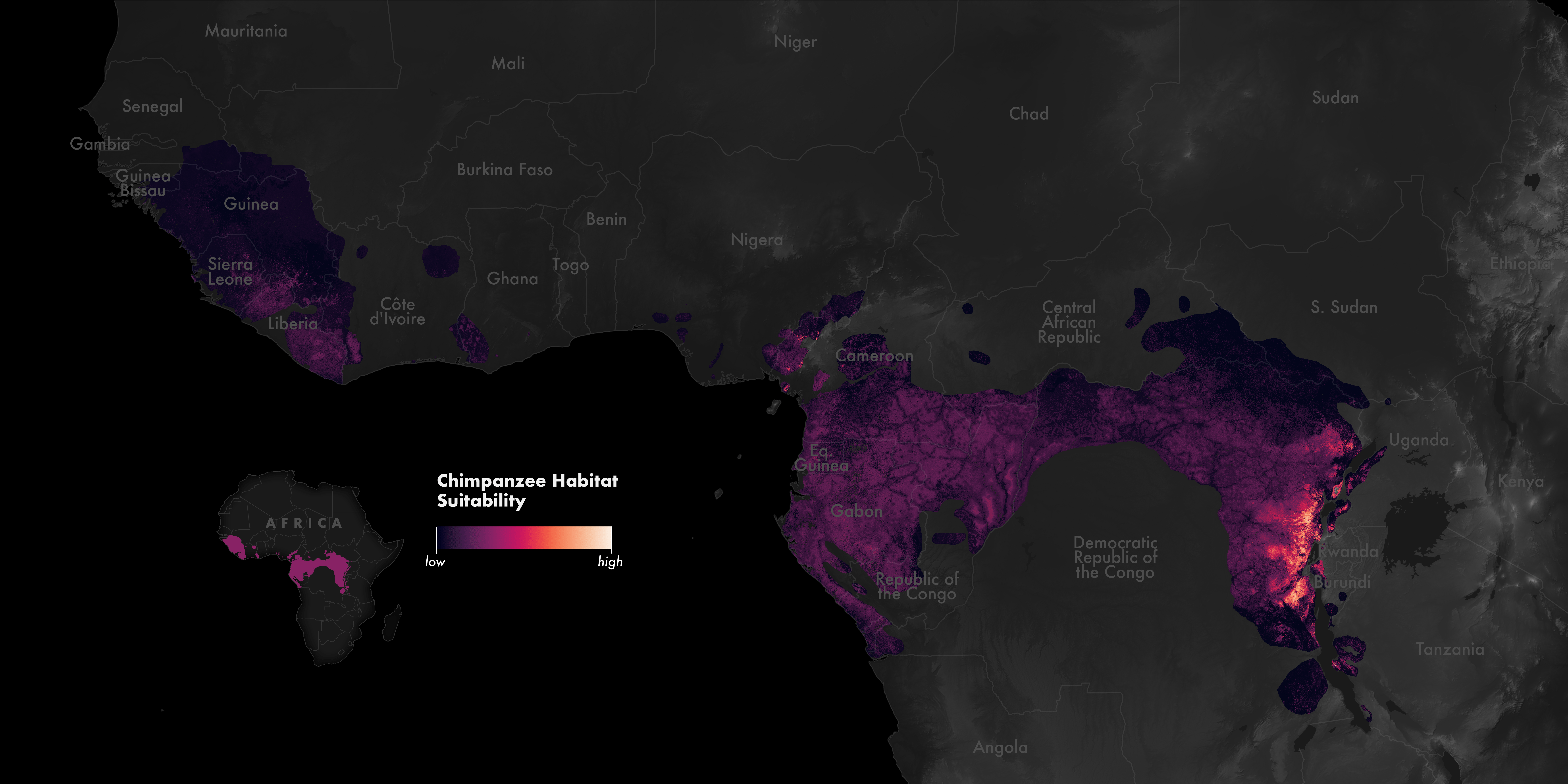
- This video from NASA that shows how the Jane Goodall Institute has been leveraging satellite imagery to track land-use and land-cover changes, used for building habitat suitability models for chimpanzee habitat conservation.
If this was forwarded to you, please subscribe to receive Earth observation insights!
One Discussion Point
Analysis, thoughts, and insights on developments in EO
5. Analysing Accenture’s Investments in EO Companies
Accenture’s participation in the recent fundraising by smallsat manufacturer and emerging EO startup Open Cosmos is quite fascinating, but not surprising. Open Cosmos, for those who are not aware, is what you would call a quintessential NewSpace company that designs, builds and launches satellites with an agile approach. Over the past couple of years, the company has been slowly, but surely starting to focus more on the EO market (like many others), with the launch of the EO platform and their shared constellation concept.
If you have read my stuff before, you already know my thesis on the importance of having a customer-focused, intermediary advisory layer in EO, with an objective, independent and holistic mindset.
I wrote about the role of technology consulting firms in EO a few months ago and how they are positioning themselves using the ‘Build-Buy-Partner/Invest’ framework. In that, I concluded partnering and investing in EO companies might be the easiest, least risky option especially if consulting firms identify some good ones.
So, what does Accenture have to do with any of this? Which layer of the EO value chain would they want to operate in? Well, it looks like almost all of them.

So far, Accenture has invested in Pixxel and Planet, two companies operating in different parts of the value chain (and in reality, still figuring that out).
What I think Open Cosmos offers Accenture is something that Pixxel and Planet cannot - flexibility: the ability to customise the data layer. Pixxel is a recently founded, hyperspectral data company focused on providing high-resolution, hyperspectral data. Fit-for-purpose, but not customisable.
Planet is a publicly listed EO company that is operating across different layers of the EO value chain, with its own roadmap and strategy. Well ahead on its journey, Planet can offer data, platform, and analytics. But, it is not in Planet’s interest to be a bespoke solution-building firm, especially being a public one.
Open Cosmos, by nature of where it is as a company, as well as with its vision for the shared constellation, offers a level of flexibility to Accenture and enables customisation as needed. So, in case Accenture, or one of its clients, wants to acquire and leverage proprietary EO data, Open Cosmos offers them a way to do that, faster and cheaper along with its platform to access and process data.
Scene from Space
One visual leveraging EO
6. EO for Emissions Monitoring and Mitigation
Many of us know the importance of satellites in global greenhouse gas (GHG) emissions monitoring. In fact, satellites, even in this early adoption phase, have proven to be so important that they could change the actual global emissions figure for the planet. A recent study showed that GHG emissions from oil and gas operations are much higher than reported to the UNFCCC.
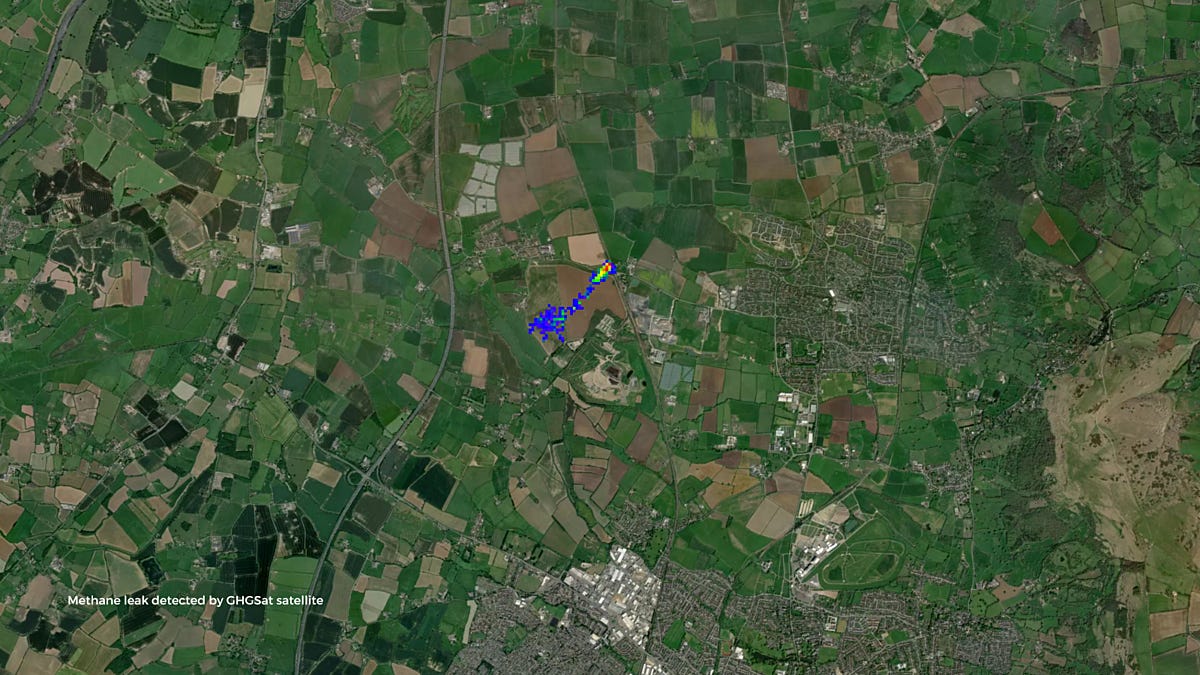
This week, the importance of satellites for real-time emissions reporting and consequent action was even more reinforced, with this case study from the UK - a major methane leak was spotted by one of GHGSat’s satellites (and later validated by ground measurements) from a gas pipeline owned by Wales and West Utilities. The pipeline operator swiftly addressed the problem, after investigation and repairs, confirmed by GHGSat’s satellites which recorded no more emissions.
PS. The exclusive deep-dive this month will be on the topic of EO for Emissions Monitoring, to be published late next week. Upgrade to become a premium subscriber to gain access!
Until next time,
Aravind


