


"Use case" might be the most overused term in Earth observation (maybe next to "actionable insights"). Every pitch deck has one. Every conference panel, including our own EO Summit, discusses several of them. Every market report lists dozens of use cases – crop monitoring, methane detection, flood mapping, infrastructure monitoring etc.
The EO industry uses the term, use case, to describe everything from a technical capability to a fully operational product, and in some cases, a whole domain. That loose usage, I think, masks the central challenge facing commercial EO: the gap between what the technology can do and what buyers actually pay for.
The EO industry has spent years demonstrating that satellite data can be applied to almost any domain. Agriculture, insurance, energy, mining, finance, environment, infrastructure — for each of these, there are funded projects, published case studies, and working demonstrations showing that EO adds value. The evidence base is enormous. And yet, commercial adoption remains stubbornly concentrated in a handful of verticals, having actually scaled in only a few cases.
Government and defence still account for the majority of EO revenue. The commercial market has grown, but far more slowly than the industry projected a decade ago. The question is no longer whether EO technology works – it mostly does. The question is why so few of these demonstrated applications have turned into products that commercial buyers operationally rely on and pay for.
In my earlier essay on the EO Adoption Curve, I explored why most commercial EO companies get trapped in pilots and projects – the Pilot Trap and the Project Trap that keep companies generating revenue without ever achieving repeatable, scalable adoption. That essay described the traps, while this one goes deeper into the mechanism underneath them. It asks what an EO use case actually is, what it is made of, how it differs from a capability or an application, and why the journey from demonstrated value to operational product fails so consistently.
This essay is built around three things. First, an updated 2026 EO Adoption Hype Cycle, looking at state of adoption of various use cases. Second, a three-stage framework that distinguishes between EO capabilities, EO applications, and EO use cases and explains why the transition between stages is where adoption stalls. Third, an analysis of what the use cases gaining traction have in common, what the stuck ones are missing, and what accelerates or blocks the path from demonstration to adoption.
The EO Adoption Hype Cycle
Below is the 2026 edition of my EO Adoption Hype Cycle. Twenty use cases, positioned based on three criteria: willingness to pay for commercial satellite data, the real state of recurring revenue and company growth behind each use case.
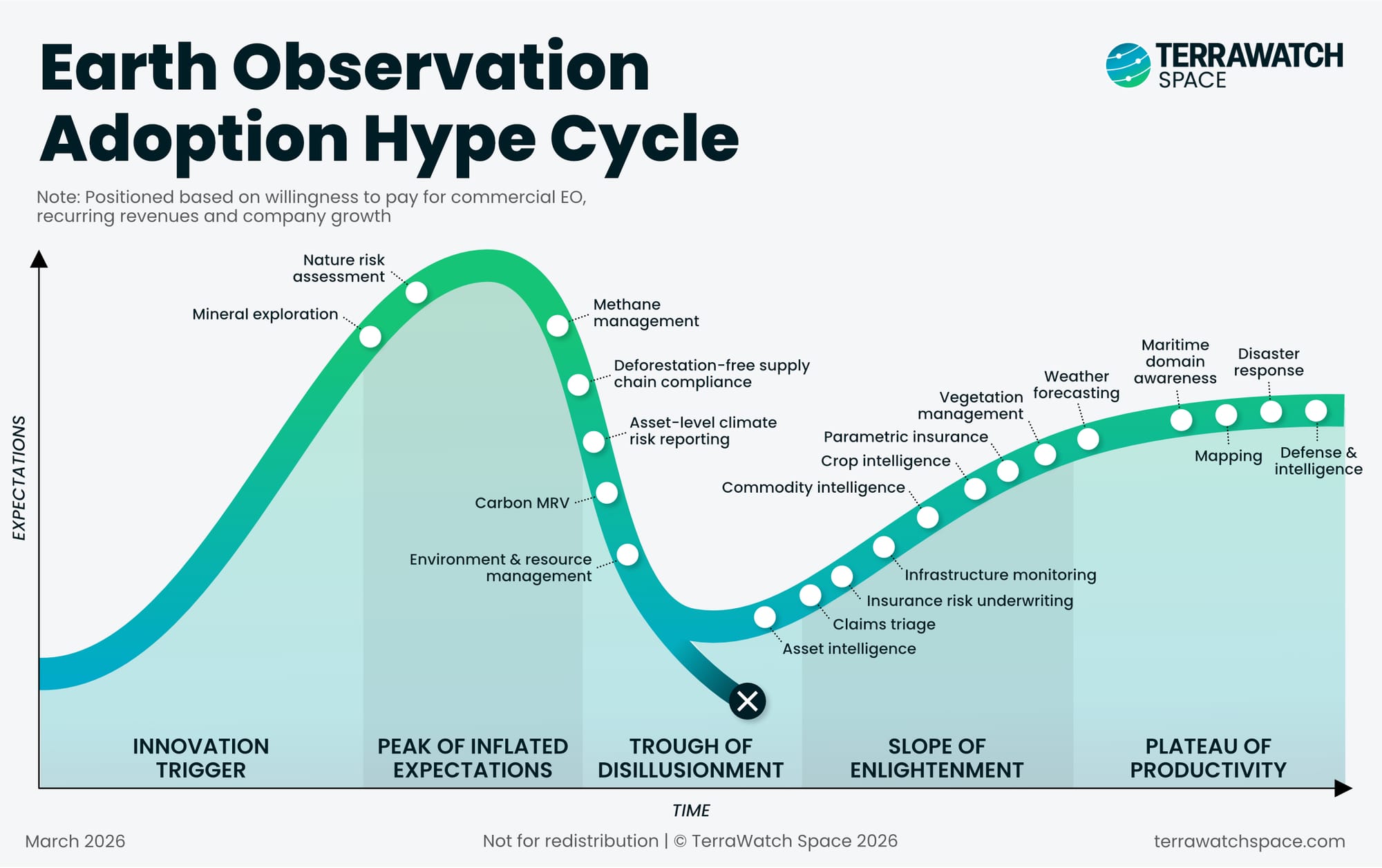
Not every use case on this chart will reach the plateau, not because of a product or adoption failure. For some, open data from Sentinel, Landsat, and Copernicus is sufficient for what the buyer needs. Commercial satellite data adds precision, resolution, or timeliness, but for certain use cases the free alternative is already good enough. These use cases may move along the curve, due to various reasons discussed later, but the ceiling for commercial EO adoption is structurally lower.
Two Main Takeaways from the Hype Cycle
First, the use cases that have reached the plateau of productivity are almost all government-anchored: defence and intelligence, disaster response, maritime domain awareness and mapping. These verticals did not "cross the chasm" the traditional way. They were built into government operations from the start, funded by public budgets, driven by institutional mandates. What that means for the rest of the curve and for the commercial EO market is the subject of this essay.
Another pattern is just as revealing: the innovation trigger is empty. Despite the wave of new satellite constellations with new sensors, and the rapid emergence of AI and foundation models for EO — no genuinely new commercial EO use cases are forming. While these advances are real and significant, the main takeaway is that most advances make existing use cases better and more viable. Hyperspectral data makes mineral exploration more precise, high-resolution SAR improves infrastructure monitoring, AI accelerates analytics across the board and so on.
The EO industry's challenge is clearly not a shortage of things it can do; it is converting what it can already do into something buyers operationally and repeatedly pay for.
So what does this chart actually tell us? Actually not a lot. The hype cycle is a useful snapshot of where industry attention sits. But as a tool for understanding EO adoption, it has a fundamental problem. In other words, after showing you the chart, I am telling you that is not very useful or sufficient at all.
The Hype Cycle Is Not Good Enough
The hype cycle shows you where use cases sit. What it cannot show you is why they sit there, or what it would take to move them.
Use cases that sit at the same position on the curve can be there for completely different reasons. One might be stuck because its market collapsed. Another because its product never moved beyond bespoke project delivery. Another because the buyers it targets adopt new technology slowly. Same position, different problems, different paths forward.
The same is true for use cases that are gaining traction. Some are succeeding because they replace something expensive the buyer was already doing. Others because regulation is forcing adoption, and others because a few companies figured out how to build a product that fits into the buyer's existing workflow. Same part of the curve, different reasons for being there.
The hype cycle tells you where, but it does not tell you why. And without understanding the why, you cannot figure out what to do next — whether you are building an EO product, investing in an EO company, or trying to adopt EO inside your organisation.
For that, you need a different lens. One that explains the mechanism behind EO adoption, and why most of what the industry calls a "use case" is not one.
EO Capabilities Are Not EO Use Cases
The EO industry has a language problem.
When an EO company says "we have a use case in insurance," what they usually mean is: we can produce a technical output — a flood extent map, a building footprint dataset, a damage severity classification — that is relevant to insurance. That is not a use case, that is a capability.
When a conference presentation shows a satellite-derived methane plume over an oil and gas facility, that is not a use case. It is a capability demonstration. When an ESA-funded project applies land cover classification to urban planning in three European cities, that is not a use case, it is a funded application.
The distinction sounds pedantic, but I firmly believe it is not. I think it actually explains the entire commercial EO adoption gap.
EO creates abundance at the level of observable signals. Satellites can detect land, water, vegetation, emissions patterns, movement, presence, infrastructure development, damage, disruption, change. The list of what EO can detect is enormous and growing every year.
But what organisations, especially in the private sector, operationally pay for - on a recurring basis, with budget allocated, integrated into their workflows - is a tiny fraction of that. The gap between what is technically possible and what is commercially adopted is not closing. If anything, it is widening, because advances in sensors, revisit rates, analytics, and AI keep expanding what EO can do without doing anything to solve the adoption problem.
This is the core issue. The industry keeps expanding what is technically possible while the bottleneck remains at what is operationally adopted.
Three Stages of EO Adoption
To understand where adoption breaks down, and why, it helps to distinguish between three things the industry routinely conflates.
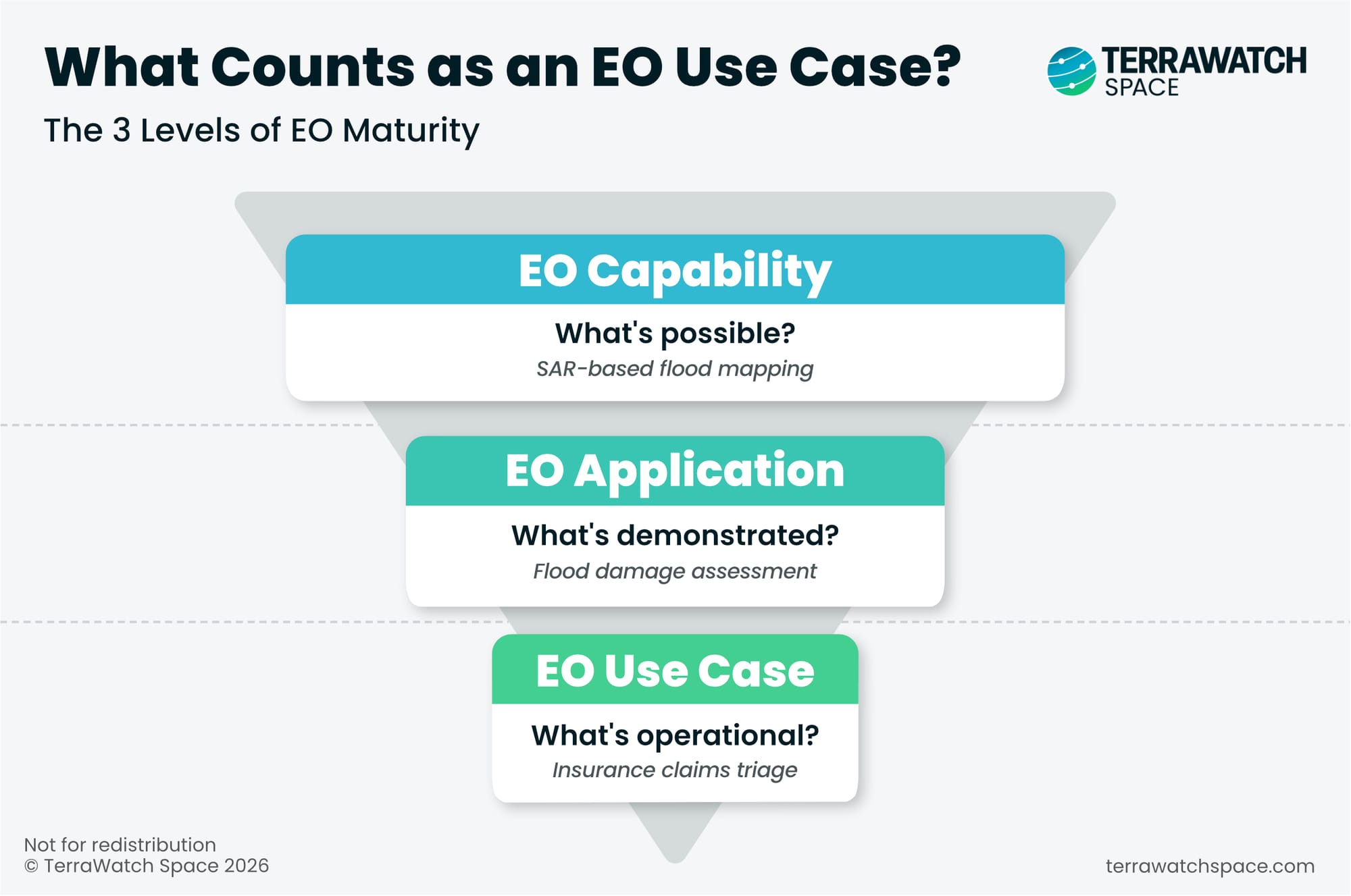
There are three distinct stages between an EO capability existing and an EO product fitting into a buyer's workflow. Understanding these stages is the key to understanding why commercial EO adoption has stalled. I think, most of what the industry calls "use cases" are stuck at stage 1 or stage 2, but I am getting ahead of myself. First, what are the stages?
Stage 1: EO Capability — What's possible
Stage 2: EO Application — What's demonstrated
Stage 3: EO Use Case — What's operational
The remainder of this essay is for Premium subscribers. It covers:
- the three stages in detail, including what a proper dissection of an EO use case,
- why government and commercial buyers are fundamentally different and what that means for the hype cycle,
- why the stage 1→ stage 2 transition is easy but also actively harmful,
- the role of AI and foundation models in stage 1 and stage 2,
- the stage 2→ stage 3 transition and why it is so hard,
- what the successful use cases have in common and what accelerates or blocks,
- what to do when use cases get stuck, including M&A as a path forward.


