


Ask anyone working in Earth observation (EO) what satellite data can be used for, and you will get a very long list: defence, agriculture, insurance, energy, climate, mining, you name it. We continue to launch more EO satellites, they work, the ways of processing and analysing the data keep getting better and – with the obligatory mention of AI in the very first paragraph – developing new EO solutions is getting easier than ever.
Hundreds of pilot projects run by EO solution providers seem to succeed, at least based on press releases. And yet, it is somewhat common knowledge that even though the EO solutions are technically advanced (and sometimes over advanced), they are not as widely adopted by users as they should and, as a result, don't scale. This is especially true for EO applications outside defence (no wonder, the market skews that way).
I have been thinking about this for years and so you may have read quite a bit of my thoughts on EO adoption, why it doesn't happen so easily and the path to invisibility. As I continued thinking about the EO adoption problem, I realised that part of the problem in our sector could simply be how we measure progress.
The yardstick most of the EO sector uses for a solution's maturity is the Technology Readiness Level (TRL) – a scale designed by NASA to assess whether a technology could survive the rigours of space, such as radiation, thermal environment and launch vibrations. Since then it has spread far beyond space, into defence, energy and even government funding programmes.
The Limits of TRL for EO Solutions
TRL answers one question well: does the technology work in its intended environment? Its job is done when it does. It says nothing about whether a customer actually uses the solution, integrates that into how they work, whether they keep buying the solution and whether other similar customers follow. For example, an EO-based flood mapping solution can be TRL 9 (the most technically proven tool) and still have zero paying customers (!).
So, if we were to just use TRL alone as an innovation mechanism in EO, we would end up with solutions that may be technically ready but never actually adopted, which would be a pity for such a revolutionary technology.
And yes, AI is now starting to widen the gap between a solution being technically ready and being adopted. As we saw in our most recent deep-dive on AI and EO, we are now looking at a future in which EO solutions are becoming much faster and cheaper to build than ever before. Put another way, a high TRL is easier to reach than ever, but it says even less about whether anyone will adopt the solution.
Say it with me: Technology readiness is not adoption readiness.
So, I decided to have a go at creating a framework to measure the entire lifecycle of EO adoption, especially for the age of AI. I wanted it to be one common scale that everyone involved, from government agencies and EO solution providers to EO users and investors, can share. Why? Because a shared adoption scale makes it easier for agencies to see when their support should end, for customers to judge how far a solution has got, and for investors to do their due diligence before investing in an EO or EO-related company.
What you are about to read comes from what I have seen work and fail, advising 50+ private and public sector organisations on their EO adoption strategy, and 80+ EO and EO-based solution providers on their go-to-market strategy, pricing and growth, over the past 6 years.
In this deep-dive, I introduce a scale for measuring adoption readiness: the EO Adoption Readiness Level, or EARL. It is, of course, inspired by TRL (hence the 9 levels) along with a few other fragmented EO adoption scales that currently exist. We will get into what each level is, how an EO solution gets there, how EARL accounts for AI, what EARL reveals when applied to real EO solutions, and how you can use it - whether you are an EO company, EO user, government agency or an investor.
A quick note on terminology in this deep-dive:
i) the “customer” refers to any organisation that uses EO or an EO-based solution – a customer is simply a user such as a company operating in a sector, a government agency or a non-profit, whether they pay for the solution or get it free.
ii) the "solution" refers to any EO-based solution, which is a software product or service that uses EO directly or indirectly.
The EARL Scale
EARL is an end-to-end scale for measuring an EO solution's adoption: from a specific problem EO could solve, to EO becoming standard practice for how that problem is solved. It rates EO solutions, not satellites or sensors – a solution that uses satellite data directly or products derived from it. The hardware bit is TRL's job, and TRL does it well, so we are just going to focus on the software.
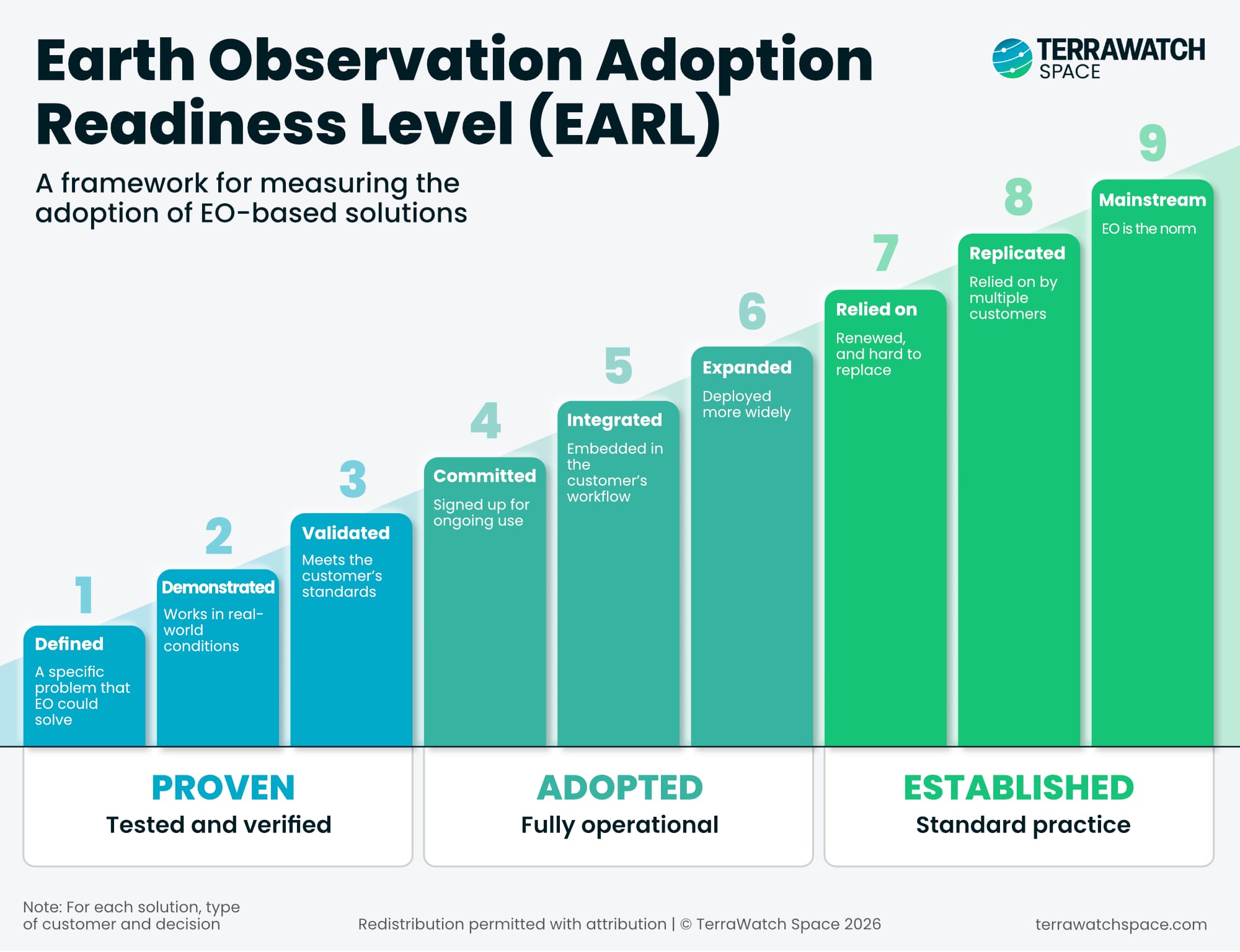
- Defined – A specific problem that EO could solve. Adoption starts with a decision, not a dataset: a specific type of customer, a specific decision, and a clear reason EO could improve it.
- Demonstrated – Works in real-world conditions. The solution works outside the lab, under the conditions the customer will actually face, with its limits stated (most of your typical EO pilot projects sit here).
- Validated – Meets the customer's standards. The customer has tested the solution on criteria such as accuracy, timeliness and compliance, and found that it solves the problem better than the current approach.
- Committed – Signed up for ongoing use. The customer commits to keep using it, in whatever form fits how it buys: a contract, a subscription, a tender or paying per use.
- Integrated – Embedded in the customer's workflow. The solution runs inside the systems and routines the customer already uses, has an internal owner, and is improving how decisions are made.
- Expanded – Deployed more widely. The customer uses the solution across the full scope it planned, such as more sites, regions, assets or internal teams, with each one counting only once the solution is shown to work for it.
- Relied on – Renewed and hard to replace. When the time comes to choose again, the customer sticks with the solution. Replacing it would mean changing how the work is done.
- Replicated – Relied on by multiple customers. The solution's success is not a one-off: several independent customers of the same type now rely on it for the same decision.
- Mainstream – EO is the norm. For the type of customer and decision being rated, using EO or an EO-based solution has become standard practice, to the point that it is invisible infrastructure, as I described in The EO Adoption Curve. And, Level 9 does not mean one solution has won: several competing solutions can reach it at the same time.
The nine levels can be split into three stages:
- Proven (1–3) - Tested and verified: The solution works, and the customer trusts it;
- Adopted (4–6) - Fully operational: The customer has committed to it, built it in and rolled it out;
- Established (7–9): Standard practice; It lasts, it spreads, and eventually it is simply how the decision is made.
Rate one solution, and EARL shows how far it has got. Rate many solutions in the same market, year after year, and it shows how mature the use of EO is in that market, and how fast that is changing.
EO Adoption Scales Already Exist
Before I go any further, I want to emphasise this point: I am not inventing EO adoption scales. EARL is not the first attempt to measure EO adoption, and it would be wrong to present it as one. Three space agencies already use scales that go beyond what TRL does:
- NASA's Application Readiness Level (ARL): NASA's Applied Science Program uses an index to track the EO application projects it funds, up to sustained use by a partner.
- ESA's Application Service Readiness Level (ASRL): ESA's InCubed Programme, which funds commercial EO products and services, uses a somewhat different scale to TRL, that runs up to a service used by paying customers.
- CSA's Application Readiness Level (ARL): The Canadian Space Agency's smartEarth initiative uses its own version of ARL for EO funding calls, up to products ready for commercialisation.
Shamelessly, EARL builds on all three, while acknowledging that these scales were created to serve one purpose: tracking projects funded by the agency and evaluating their maturity. So, naturally their ratings end when the funded project ends. That is actually their purpose, not a flaw.
EARL picks up where they stop, and it adds two things.
First, it follows adoption beyond the first use by a customer. Once an EO solution technically works and someone actually buys it, what matters next is whether that buyer keeps buying, and then whether other buyers do the same, ultimately ending with the EO-based solution becoming standard practice for that type of customer to solve that problem.
Second, it accounts for AI, which none of the three scales do. AI is already bringing quite a bit of change to the EO sector, lowering the barriers to build and demonstrate EO solutions. It is bringing new competition, from off-the-shelf AI tools (like Planet’s agentic AI) and from what customers can now build themselves using embeddings (like Google’s AlphaEarth). And new, non-human buyers of EO may be entering the fray, as customers’ AI agents could start to buy and use EO directly.
Who EARL is for
EARL is for anyone who has to judge an EO solution's adoption:
- EO solution providers, to show customers and investors what level their EO-based solution has reached;
- EO users, from enterprises to government agencies, to see where their own adoption of a solution stands, and what it needs from them to move forward;
- In-house EO/geospatial teams, to track how widely what they build is adopted across their organisation;
- Agencies and investors, to decide what to fund and evaluate the maturity of EO solutions in a specific market.
And, no, I am not the EARL-issuing authority, and I do not expect an organisation to be (no single entity will have all the required information). Ideally, I expect anyone to be able to rate an EO solution themselves, with the evidence they have: an EO or EO-related company rating its own solution, a user rating what they buy, a space agency rating a solution it funded, or an investor rating a company they are looking at.
How to Read the Scale
Before rating an EO solution against the scale, it helps to know some rules behind every rating.
One rating per solution, per type of customer, per decision
EARL doesn’t rate a company, or a solution in general. The “customer” is any organisation using the solution for a decision, whether a company, a government agency or a non-profit, paying or not, including other teams served by an internal EO team in the same organisation. So the same solution can sit at very different levels.
The type of customer matters for the same solution too -- satellite-based methane detection can be at level 5 for oil & gas producers fixing leaks, but still only at level 2 for landfill operators.
Levels are cumulative, even when events aren’t in order
To reach a level, a solution must have met every level below it. Steps often happen in a different order in practice, but a level only counts once everything below it is proven.
Ratings are dated, and they can go down
If something the solution depends on changes or is affected – such as switching to different type of satellite data, a change of internal owner for procuring EO solutions, or the data it relies on no longer being available, the rating is rechecked.
EARL is not a ranking or a business review
It assesses each solution on its own evidence, not against competitors. Whether a vendor makes money is a question for due diligence: an EO solution sold below cost can still be relied on (obviously, not great for the company selling it)
One of them may even be losing money on every contract and still be relied on by its customers. EARL rates the reliance of the solution, the losses are for investors to judge.
How EARL treats AI
AI makes EO solutions faster to build, but not easier to adopt. The question every solution now faces is whether it is better than what the customer could build with AI. EARL takes AI into account in two ways:
- AI is a rival a solution has to beat. At levels 1, 3 and 7, the question is no longer only whether a solution beats the customer's current method. It is also whether it beats off-the-shelf AI tools, such as those from Google or Planet, and what the customer could now build itself with open models and embeddings like OlmoEarth or LGND.
- AI may also become a buyer and user. At levels 4 and 5, a customer's AI agents could increasingly buy and use a solution directly. SkyFi, an EO marketplace, introduced a new feature lets agents order imagery themselves, and its app on Robinhood feeds satellite data straight into investors' AI agents, which can use it in trading decisions without anyone looking at the imagery.
Whether AI is the rival or the buyer, the test EARL will do stays the same: is the solution adopted, and does that adoption last?
The rest of this essay is for Premium subscribers. It continues with:
- Why Technical Readiness is not Adoption in EO
- The Nine EARL Levels in Detail, with examples
- How EARL accounts for AI – as a Buyer and a User
- Five Takeaways from Applying EARL to Real EO Solutions
- How to Use EARL: For EO Companies, EO Users, Agencies and Investors
- Closing


