


Welcome to another edition of Earth Observation Essentials, the free biweekly newsletter from TerraWatch covering key highlights from the EO market along with exclusive insights and analysis.
If you would like a more detailed, comprehensive market briefing with exclusive analysis, delivered every week, become a Pro subscriber, or a Premium subscriber, for more deep dives on EO markets, technologies and applications.
📈 EO Market Highlights
Major developments in EO
🛰️ Pixxel announced a strategic partnership with Sarvam, an Indian AI startup to develop and build India’s first orbital data centre satellite, with the former providing the satellite and the latter the AI models.
📈 Enagás, a Spanish energy firm signed an agreement with EO-based infrastructure monitoring solution provider Orbital Eye to deploy satellite-powered monitoring across its entire gas pipeline network in Spain.
Three things I believe made this convert to an operational deployment: i) the use case is binary, ii) the alternative is physically patrolling 9,000km of pipeline, and iii) there's a single buyer with authority to deploy nationally.
That is three conditions most commercial EO use cases can't meet — the output is ambiguous, the alternative is cheap enough, or the procurement is fragmented across dozens of decision-makers.
💰 Radiofrequency monitoring firm HawkEye360 went public in the New York Stock Exchange and raised $416M, valuing the company at $3.1B.
🤝 Loft Orbital, together with Magellium Artal Group, signed a multi-year contract worth up to tens of millions of euros with CNES for the deployment of a new EO constellation of 10 multi-sensor satellites and a ground segment.
In the TerraWatch Pro newsletter this week, I analysed the three different models of sovereign EO programmes, what each of them trade-off and why most of them are likely to fail, with a caveat.
Upgrade to a Pro subscription for just $75 per year to check out the analysis and receive weekly market briefings.
💡 Insight Bytes
A quick dose of analysis from TerraWatch
Orbital Data Centres Are Really an EO Business (For Now)
Starcloud recently closed a $170M Series A at a $1.1B valuation to build data centres in space. The long-term play is competing with terrestrial hyperscalers, but that requires Starship-era launch costs that are years away — Starcloud CEO Philip Johnston puts that at 2028-2029.
So, the near-term business? Selling on-orbit processing power to EO satellite operators: Starcloud's first satellite is already analysing radar data collected by Capella Space's SAR constellation in orbit.
EO as Anchor Demand for Orbital Data Centers
There is a pattern here worth noting. Government contracts were the anchor demand that allowed commercial EO constellations to get built. Now those same EO constellations are becoming the anchor demand for orbital compute. In other words, each new infrastructure layer in space depends on the one before it to generate enough revenue to get started.
Starcloud needs the EO constellation market to keep growing - more satellites, more data, more demand for on-orbit processing - to sustain its business until the hyperscale economics become viable. That makes Starcloud's trajectory as much a bet on the EO market as it is on orbital compute.
And just as EO companies remain dependent on government revenue long after those initial anchor contracts, Starcloud may find that EO workloads remain core to its business longer than the valuation narrative suggests.
Starcloud's trajectory is as much a bet on the EO market as it is on orbital compute.
What changes if this works
Today, EO operators face a choice: process onboard with limited hardware, or downlink everything and process on the ground. A mature orbital compute layer introduces a third option: outsource processing to a nearby node (built by Starcloud or its biggest competitor SpaceX) and focus purely on sensing.
That changes how you design a satellite, what you put on it, and what you spend. It could drive a separation between sensing and processing that reshapes the architectures of future satellites. They could become lighter and cheaper, optimised for collection, with compute handled as a service layer in orbit. But, I am getting ahead of myself.
TL;DR: Starcloud is a unicorn because investors are betting on the terrestrial data centre disruption market. But the road there is measured in EO contracts, not GPU benchmarks. How long 'for now' lasts depends on Starship, launch costs, and whether EO operators keep buying. Until then, orbital data centres are an EO business – whether they like it or not.
EO Summit: Standard Ticket Sale Open
If you want to register for EO Summit, now is the time, as prices will go up after May 22!
If you are working in the EO sector, come hear how satellite data is being used in applications across insurance, finance, energy, emissions, agriculture, nature, defence and disaster management.
If you are an enterprise or government user of EO, come hear directly from peers who are using satellite data to solve the same problems as you are and meet the EO sector in one place.
Looking forward to seeing some of you in person in London!

🔍 Recommended Reads
Interesting links to check out
- This analysis based on satellite observations showing how the methane emissions from coal mines have grown fiftenfold.
- The latest report from the World Resources Institute on deforestation (which is slowing down), but wildfires are increasingly becoming a bigger threat.
- This article presenting how the recently launched NISAR mission can be used to track ground subsidence.
🛰️ Scene from Space
One visual leveraging EO
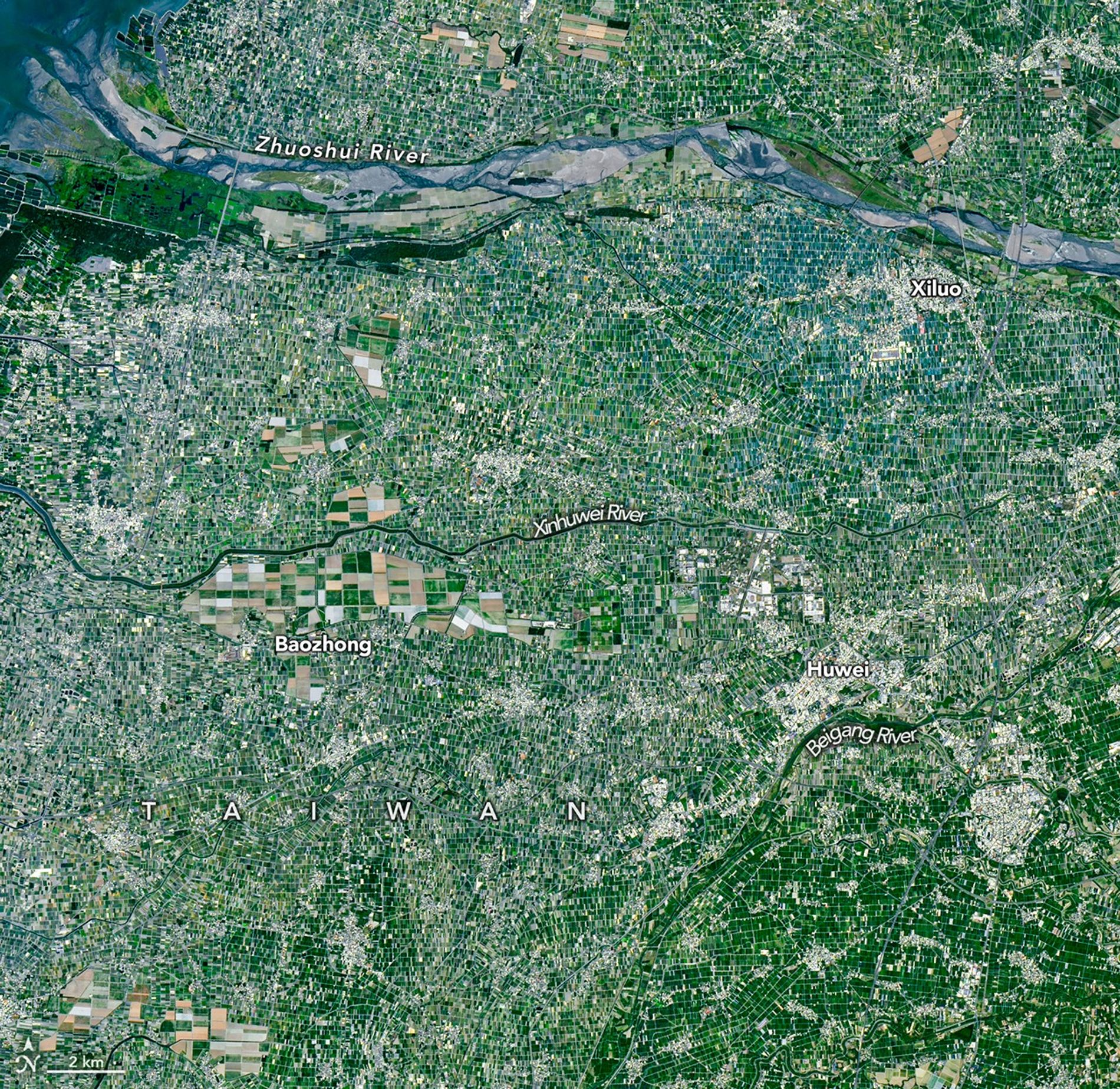
Taiwan's Tiny Farms
For today's image, I picked out this beautiful mosaic of Taiwan taken by Landsat and shared by NASA showing the small farms producing a variety of crops including rice, sweet potatoes, peanuts, corn, sugarcane, garlic, scallions, coffee, fruit, and leafy greens.
As the article notes, "the average size of a farm in Taiwan (less than 1 hectare) is much smaller than in the United Kingdom (87 hectares) or the United States (187 hectares)" – which also points to the challenge of applying crop monitoring algorithms developed for Western farms to Asian ones, where small farms like these are the norm.
Until next time,
Aravind.


