


In this deep dive, we unpack the key investment trends shaping the Earth observation (EO) sector in the first half of 2026, breaking down funding activity by segment, region, growth stage, sensor and year-over-year comparisons.
Beyond funding, we also review notable developments across the EO landscape, including M&A activity. Finally, we look ahead to H2 2026, outlining the dynamics that could shape the next half of the year.
A few disclaimers before we get into the analysis:
- The funding figures are based only on venture capital and private funding rounds - grants and other public procurement contracts are mentioned separately where relevant, but are not included in the totals.
- While we touch on the performance of publicly traded EO companies ($PL, $BKSY, $SPIR, $SATL), it is only at a high level to contextualize the private fundraising landscape.
- The analysis is limited to the EO sector, it does not include anything related to the broader space industry (see the EO value chain below for details).
Here is what we have in store for this briefing:
- The TerraWatch EO Value Chain
- EO Investments in H1 2026
- Comparing EO Investments: H1 2026 vs 2025 vs 2024 vs 2023
- By Funding Round Size
- By Region
- By Sensor
- Major EO Developments in H1 2026
- M&A and Consolidation
- Public Market Snapshot
- Other Major Developments
- What to Expect in H2 2026
The TerraWatch EO Value Chain
Before diving into the analysis, here’s a quick recap of how we define the EO value chain at TerraWatch. While this continues to evolve, as the market evolves, this framework underpins the segmentation used throughout this review (and everything else you will see from us).
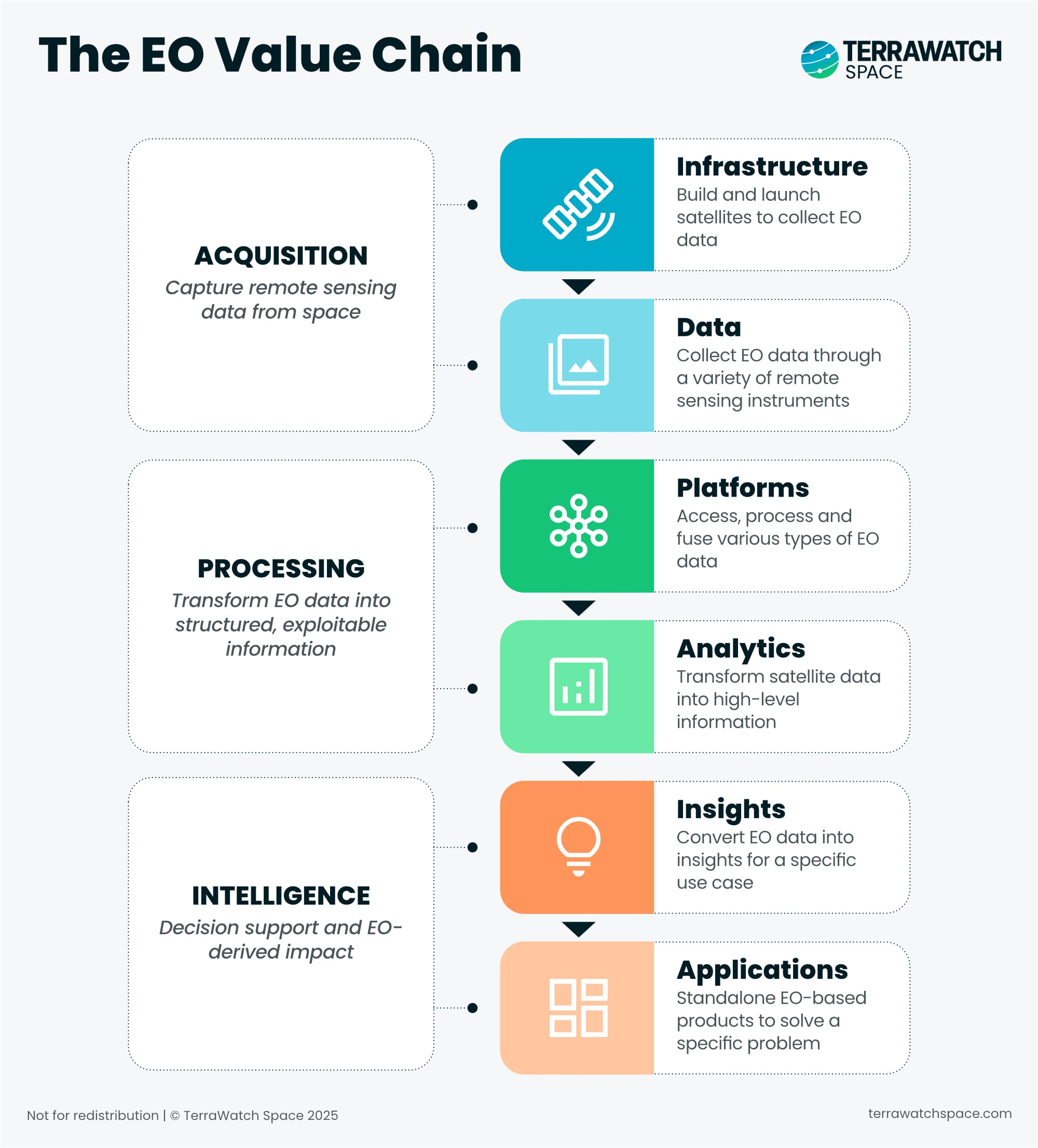
The EO value chain is structured across three broad stages: Acquisition, Processing, and Intelligence, which are further broken down into six core segments, as described below.
- Infrastructure: Includes companies that build the satellites predominantly meant to launch EO instruments.
- Data: Refers to the collection and delivery of EO data from satellites through various remote sensing instruments.
- Platforms: Platforms allow users to access, process, and integrate EO data from multiple sources via APIs and preprocessing workflows.
- Analytics: This segment transforms raw satellite data into structured, high-level information.
- Insights: Involves converting EO data into useful insights by aggregating and interpreting the previously derived analytics to support specific decisions.
- Applications: Standalone tools that use EO among other sources of data to solve concrete problems in a specific domain.
EO Investments in H1 2026
The total investments in EO over H1 2026 are estimated to be $1.7B, with Acquisition and Intelligence segments contributing to more than 80% of all the funding raised, which is in line with the usual trends.
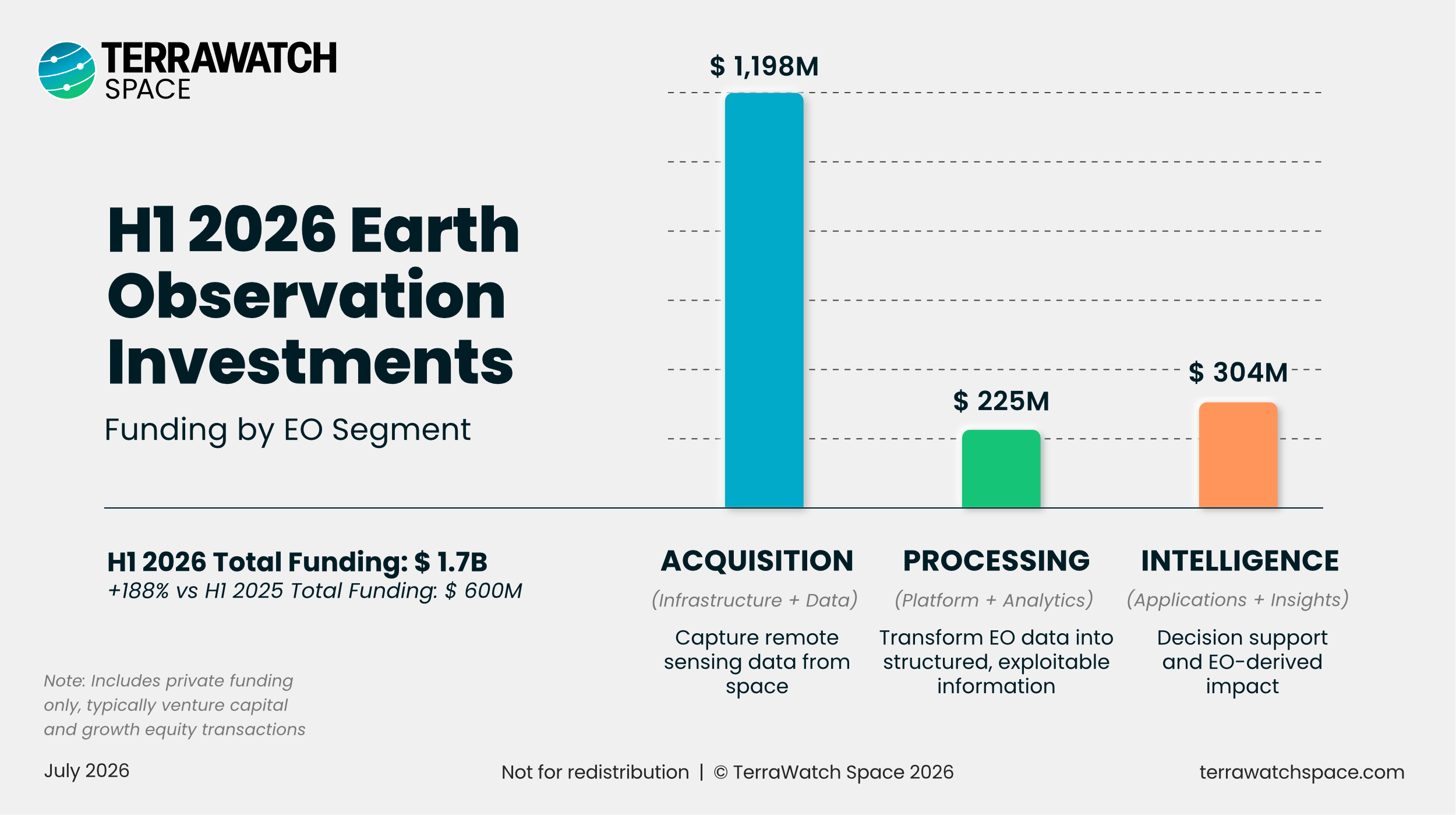
Companies in the Acquisition segment had an excellent first half of the year, raising a total of almost $1.2B, well ahead of previous years in terms of volume. The largest rounds came from ICEYE ($520M) now valued at over $12B, Tomorrow.io ($210M) with reported recurring revenues of over $100M, and Xoople ($130M), which has now moved from the Processing segment to the Acquisition segment, after their plans to launch a new EO constellation.
The Processing segment is evolving as highlighted in my note below. This segment which barely has a 1-2% share in the overall EO funding raised shows a larger figure than usual. This mainly stems from including Starcloud's $170M round, a company developing and launching orbital data centers. The rationale for including it is because today they are mainly an EO business (which was also acknowledged by its founder). Other major rounds included $12.7M for EO platform SkyFi and $11M for edge computing hardware manufacturer, Ubotica.
In our value chain, Processing means turning EO data into something usable, and until now that has always happened on the ground. Companies like Starcloud are enabling the transfer of that step to take place in orbit - for instance, with its processing of data collected by Capella Space's radar satellites.
The wider, more interesting, point is that the segment boundary is starting to move. Where processing happens is now becoming a design choice rather than a given. Starcloud's inclusion in Processing reflects where the segment is heading rather than where it has been.
The Intelligence segment had a quieter first half of the year as tech investors' appetite shift towards funding atoms than bits. Unsurprisingly the two verticals that lead this segment are Defense & Intelligence – through deals like Striveworks ($33M) and Solafune ($30M) both focused on building GEOINT platforms and Climate & Environment – through deals like hummingbirds ($55M) and Varaha ($20M) both focused on nature-based solutions. Others such as Lithosquare and Terra AI, building mining applications using EO were also part of the mix.


