


Welcome to a new edition of Earth Observation Essentials, the free biweekly newsletter from TerraWatch covering key highlights from the EO market along with exclusive insights and analysis.
If you would like a more detailed, comprehensive market briefing with exclusive analysis, delivered every week, become a Pro subscriber, or a Premium subscriber, for more deep dives on EO markets, technologies and applications.
📈 EO Market Highlights
Major developments in EO
🛰 NASA’s cheapest missions deliver less scientific bang for the buck, a study from the Planetary Society found. This might probably be not true for EO given the success of NASA missions like TROPICS and CYGNSS among others.
🇨🇳 Chinese satellite manufacturer Changguang Satellite Technology Co Ltd (CGSTL) raised $736M in funding from investors that included mainly provincial governments and state-backed funds. CGSTL which has about 161 satellites launched so far, said that the new round of financing will be to improve its EO capabilities.
So, while this equity injections and state investments can be seen as a bailout, this may not be any different from the equivalent of EO data procurement in the West. The financial mechanism is different, but the strategic outcome is identical - especially for an asset like CGSTL.
🧊 Vantor announced the launch of WorldView 3D, a new product providing an up-to-date 3D ground truth layer for missions that depend on an accurate model of the physical world. The offering would enable customers to task and receive 3D data anywhere on Earth within 24 hours of image collection.
📈 Canadian space industry leader MDA Space is acquiring approximately 70% of French EO analytics firm CLS (Collecte Localisation Satellites) for €567M in cash – making it one of the bigger transactions in the downstream EO market.
In the TerraWatch Pro newsletter this week, I wrote about what this deal tells about the business of EO, considering CLS is one of the largest downstream businesses globally with projected revenues of €286M.
Upgrade to a Pro subscription for just $75 per year to check out the analysis and receive weekly exclusive market briefings.
💡 Insight Bytes
A quick dose of analysis from TerraWatch
The following insight brief is part of the TerraWatch Pro newsletter provided here as a preview for free subscribers. For receive weekly exclusive insights and analysis, become a Pro subscriber.
Traditional Weather Models vs AI Weather Models
Recently, Google DeepMind shared how its AI weather model WeatherNext helped the US National Hurricane Center predict Hurricane Melissa's Category 5 landfall in Jamaica. Reports say it outperformed every other model used that season. Which raises the obvious question: what does this mean for how weather gets predicted in the future?
NWP vs AI
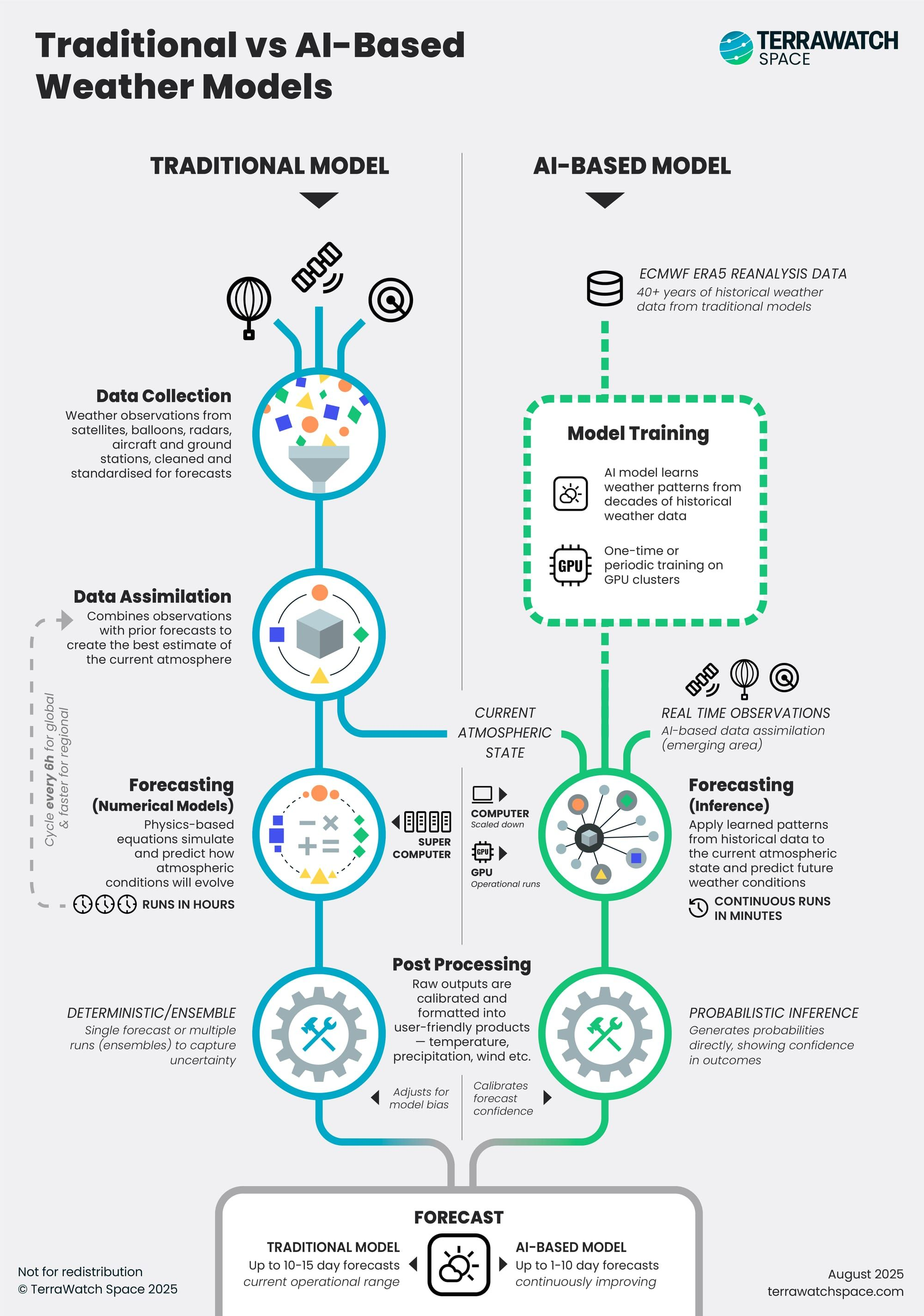
For decades, weather forecasts have been generated almost exclusively through Numerical Weather Prediction (NWP) – massive physics-based equations processing the atmospheric data derived from satellites, running on some of the world’s fastest supercomputers. Now, a new wave of AI-driven models is challenging that paradigm, offering forecasts in minutes on GPUs or even laptops.
The shift is not about replacing one with the other, but understanding how these two approaches compare and where they may converge.
NWP Models
NWP begins with taking the observations, merging them with prior forecasts through a process called data assimilation to produce the best estimate of the current state of the atmosphere.
From there, physics equations simulate how the atmosphere evolves forward in time. These runs typically cycle every six hours for global models, producing deterministic forecasts or multiple ensemble runs to capture uncertainty, extending out to 10–15 days. Post-processing then refines these outputs, correcting biases and downscaling them into forecast products that can be used by the general public.
NWP has the advantage of decades of development, institutional trust, and physical explainability, but it is expensive and slow to run.
AI Models
AI takes a very different route. Instead of solving physical equations directly, machine learning models are trained on decades of historical data, mainly from reanalysis datasets like ERA5, which helps learn the patterns in atmospheric evolution.
Once trained, the model produces forecasts in minutes, ingesting the current atmospheric state. These models generate probabilities directly – showing how confident they are in different outcomes. Forecasts still need adjustment and calibration, often checked against NWP models, but the speed advantage is huge.
While they are fast, the trade-off with AI models is that these models continue to be dependent on traditional models and (as with any AI) less transparent in how the predictions are generated.
Towards a Future of Hybrid Models
In practice, the two approaches are already blending: AI models are often calibrated against NWP baselines, while meteorological agencies explore hybrid systems that combine physics and machine learning. The biggest open question is trust: NWP has decades of institutional validation, while AI still faces scrutiny over explainability, extreme events, and consistency beyond the short term.
For example, ECMWF is already running its AI model (AIFS) in parallel with its flagship NWP system, signaling a hybrid future rather than a replacement.
The Role of Satellite Data in Both Approaches
What is often missed in the AI-versus-NWP framing is what both approaches share: a dependence on observational data, the bulk of it from satellites. Over 90% of the observations assimilated into operational NWP systems come from satellites and removing satellite data from NWP degrades forecast skill at all lead times more than removing any other observation type.
AI models inherit the same dependency, just one step back. They are trained on reanalysis datasets like ERA5, which is itself built on decades of satellite-derived observations, and they are initialised at runtime from analyses produced by NWP systems running on those same observations.
That means the AI weather revolution sits on top of the global satellite observation network. Better models extract more from the same data, but they cannot create information that isn't there. If anything, AI weather forecasting raises the stakes for keeping the global observation network — both the public satellite missions (NOAA, EUMETSAT, JAXA etc.) and the commercial constellations from operators like Spire, Tomorrow.io, Weather Stream, PlanetiQ etc. that increasingly extend them — funded, modern and continuous.
AI models can ingest observations at cadences and volumes traditional NWP couldn't, which is part of why commercial weather constellations are now scaling alongside the AI weather models themselves.
Whichever paradigm, AI, NWP, or hybrid, comes to dominate weather forecasting, the foundation of what any of them can deliver is set by the satellite observation network underneath.
🔍 Recommended Reads
Interesting links to check out
- New research from the UK Met Office shows AI can produce trustworthy, physically realistic weather forecasts.
- Microsoft announced the release of its foundational model, Aurora 1.5 with applications across weather, energy, agriculture and climate sectors.
- ECMWF is assimilating new cloud radar data from the EarthCARE mission into it its global forecasting system, marking the first time any operational forecasting center has assimilated this type of data.
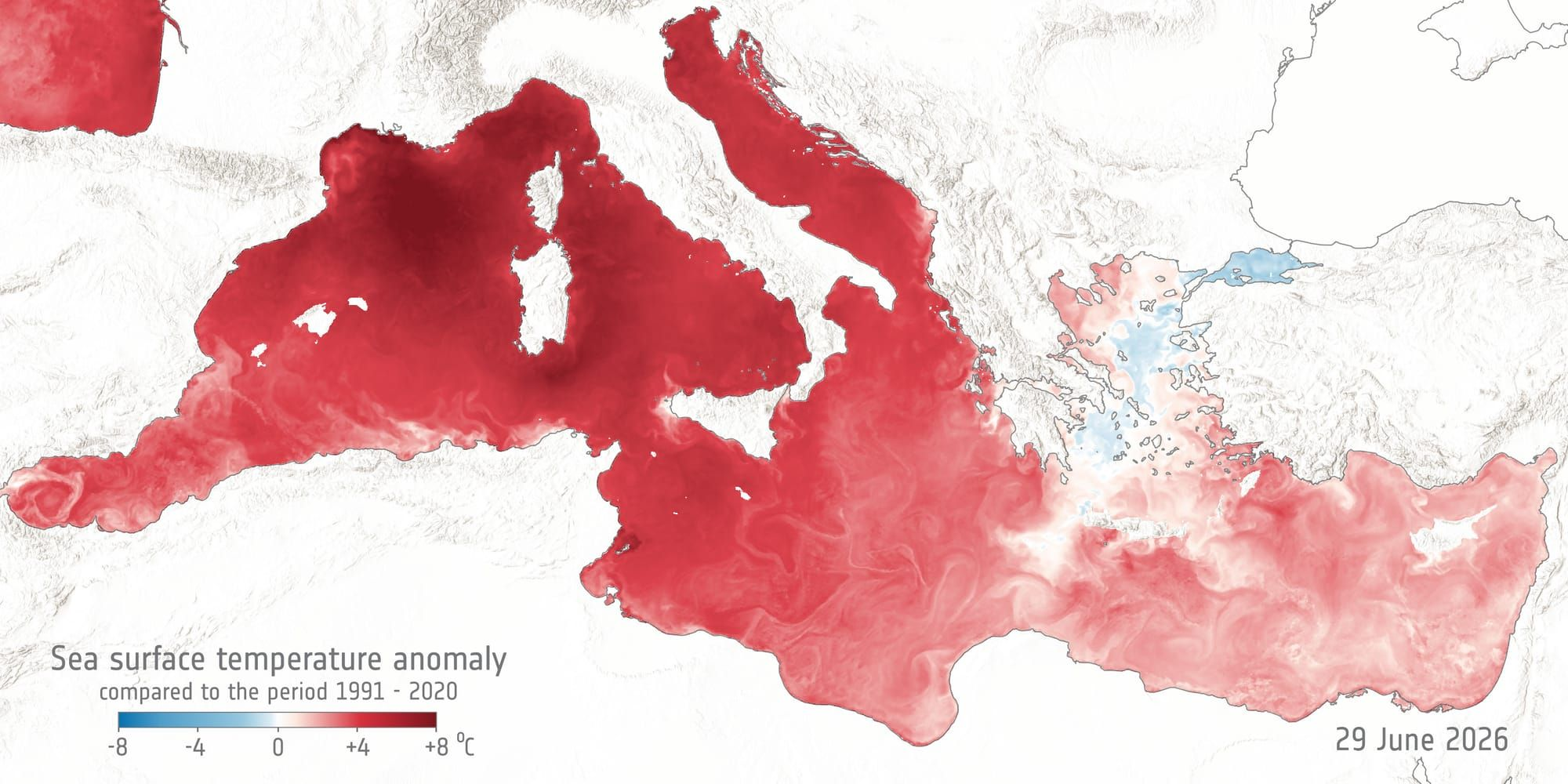
- Data from the Copernicus Marine Service showed that Mediterranean Sea has broken the sea surface temperature record for June.
🛰️ Scene from Space
One visual leveraging EO
Analysing the Earthquakes in Venezuela using SAR
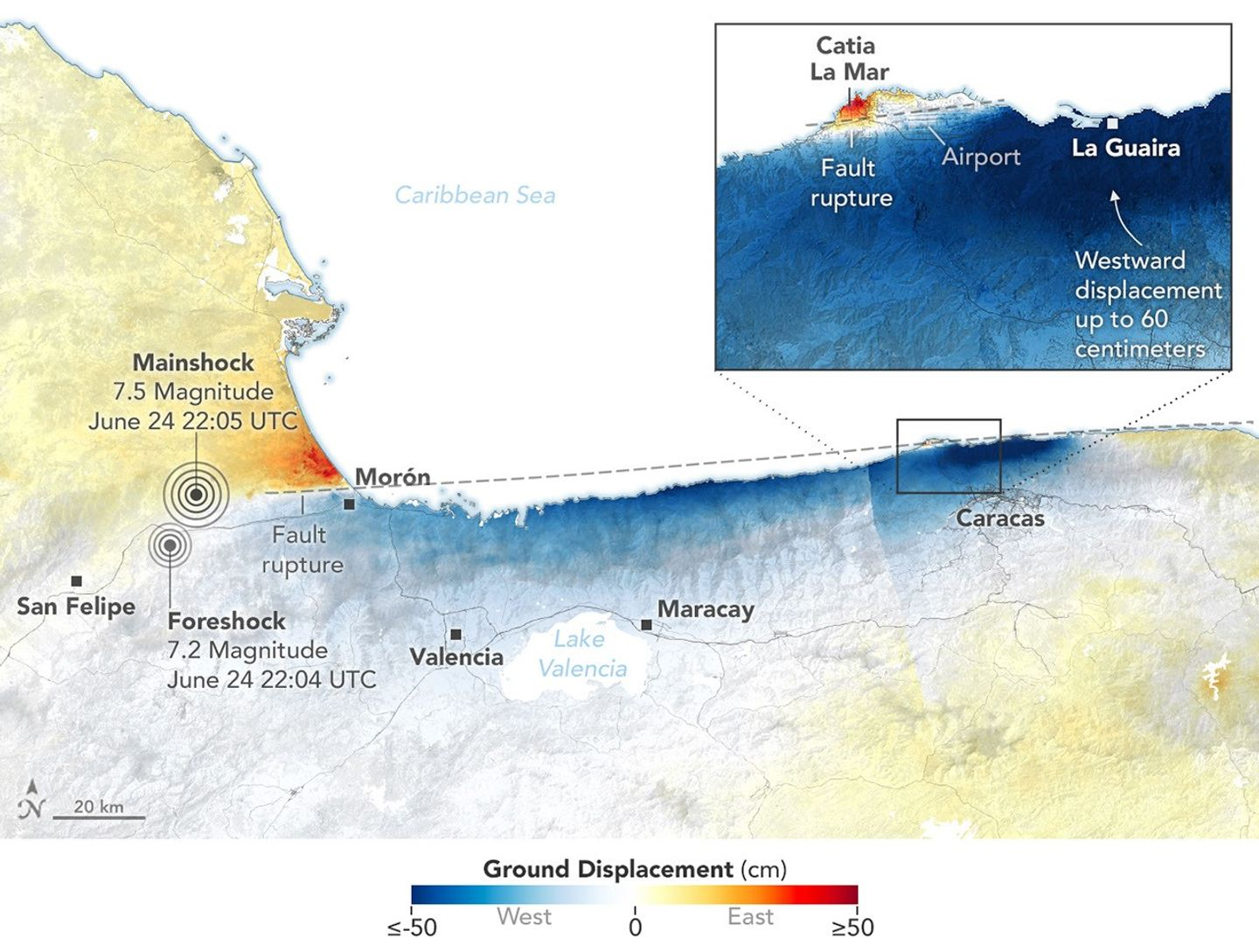
Two earthquakes of magnitude 7.2 and 7.5 struck northern Venezuela in June, causing huge damage and loss of life across the region. Scientists from NASA JPL produced maps of ground displacement leveraging data from the NISAR mission, which revealed how the land surface moved and insights on the cause and effects of the disaster.
Using a technique called InSAR, the team compared data from repeat passes to detect subtle changes in the distance between the satellite and the ground. The map below shows areas in red where the ground moved east and up and areas in blue where the ground moved west and down.
Until next time,
Aravind.


