


Hey! This is my first newsletter after officially launching TerraWatch Space. You will continue receiving the newsletter, but some housekeeping points below.
- As you can read from my brand new website, you will receive at least 3 editions of the newsletter every month, starting in September - one on the 1st, the 15th & the 25th, and occasionally another additional one.
- I am playing around with the format a bit, as “8-Things EO” will now start being published on a monthly basis as opposed to once a quarter.
- Your organisation can now be featured on the newsletter whether it is for building brand awareness, covering a major announcement, advertising an event or discussing a case study. More details below.
Now, without any further ado, let’s get to this belated edition of 8-things EO (from September, it should hit your inboxes on the 1st of each month).
2 Curated Things
A non-exhaustive summary of key developments in EO from the last month.
1. Funding, Investments and Financial Stuff 💰
- Astraea, a US-based startup building an innovative EO platform raised a $6.5 million Series A from climate-focused VCs to commercialise their platform focused on climate change - is this this the start of verticalisation of platforms?
- LiveEO, a German startup raised €19 million for scaling up their infrastructure monitoring solution, leveraging EO data - one of my favourite companies with a pragmatic, yet optimistic vision for the future of EO (LiveEO on my pod 🎙️)
- Yunyao Yuhang, a Chinese space company raised $14.8 million in “Pre-A+” funding to build & launch a constellation of weather satellites measuring radio occultation and reflectometry signals - more on commercial weather below 👇
- Spinergie, a French startup in the maritime space raised €11 million to build their AI-based maritime platform that leverages satellite data.
- Vibrant Planet, a US-based startup building a forest management platform leveraging satellite imagery raised $17M seed round - companies like this one and Spinergie, that we will never hear about, will define the future of EO.
- Arable, a US-based agtech startup raised $40M in Series C to scale their field intelligence platform that leverages their proprietary in-situ sensors - important to keep track of companies that continue to use alternative sources of data.
2. Contracts, Partnerships and Strategic Stuff 📈
- Private equity firm Antarctica Capital has acquired EO platform company Descartes Labs, expanding their portfolio that includes EarthDaily Analytics.
- Kayrros and Absolut Sensing, two French startups, have signed an agreement letting Kayrros allowing access to emission data collected by Absolut Sensing's hyperspectral sat constellation for their monitoring products.
- Tensorflight, a startup operating in the property insurance space is partnering with Airbus Defence & Space Intelligence to use Pléiades Neo's 30 cm imagery for enhancing property assessments (Airbus on my pod 🎙️).
- Planet signed a contract with Bundesamt für Kartographie und Geodäsie, the German federal mapping agency. Planet is also providing NOAA to data for tracking oil spills, marine debris and marine life.
- Microsoft announced the Azure Space Partner Community, in an attempt to structure its go-to-market strategy within EO and the wider space industry.
- BlackSky won $4.4M contract to work on a US Intelligence project aimed at automating quantitative analysis of satellite imagery using machine learning.
- The National Reconnaissance Office has released an RFP for commercial satellite-based radio frequency data, which should be good news for some players including HawkEye 360, Kleos, Spire etc.
- NOAA has awarded (pilot) contracts to GeoOptics, PlanetIQ & Spire to test the value of commercial radio occultation data for space weather forecasting.
Subscribe to TerraWatch Space.
4 Deep Dives
An analysis of four major trends and developments in Earth observation
3. The Future of Commercial Weather Data from 🛰️
I shared this insightful graphic (sourced from this tweet) on social media and it received over 50,000 views, once again proving the power of visualisation. I have written about the gap in (unequal) global weather observations and the importance of satellites, and this graphic does a wonderful job showing the coverage of ground weather stations, or the lack thereof. Commercial Earth observation companies have a very important role to play, and I saw that first hand during stint at Tomorrow.io.
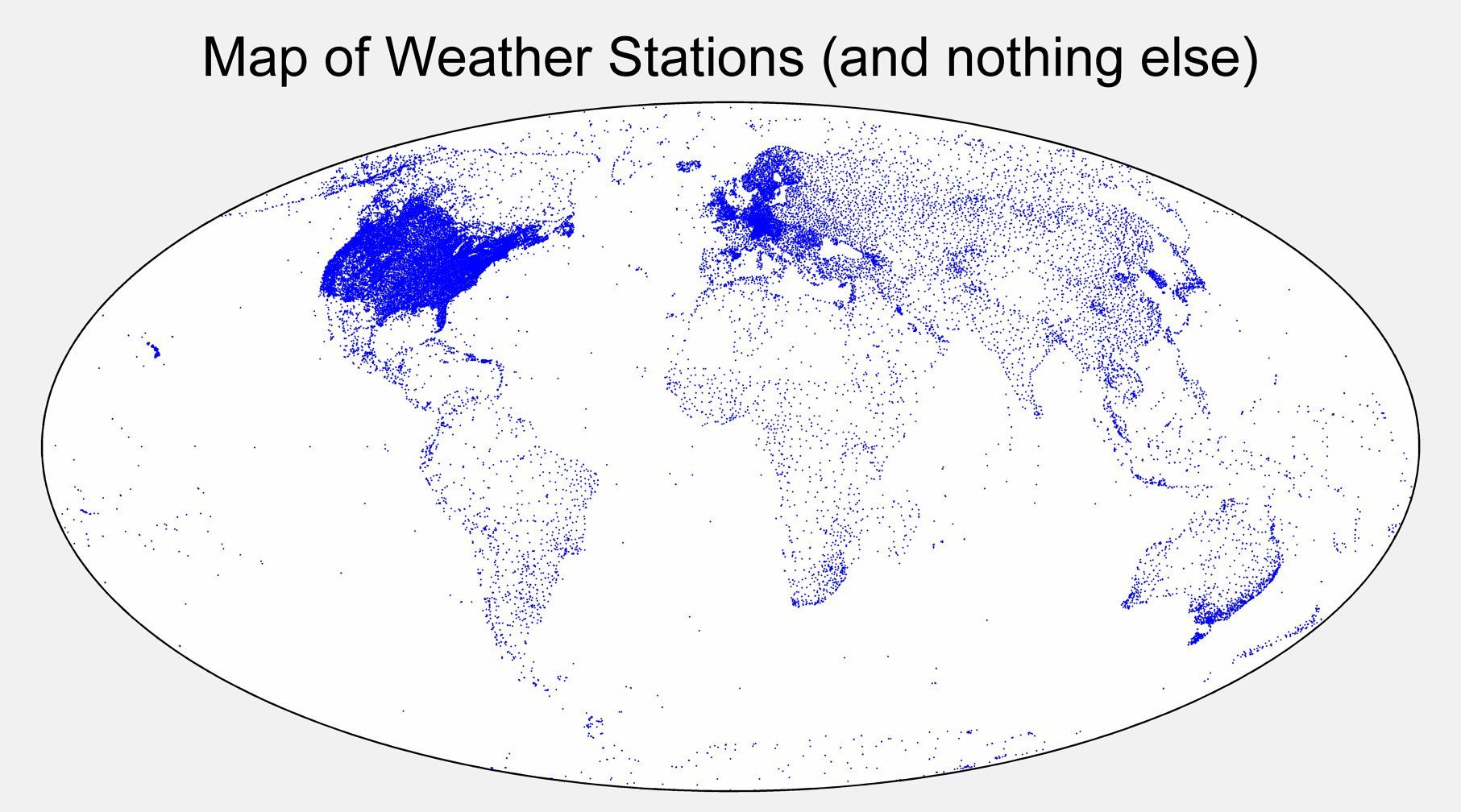
Why is this relevant? This month we saw two major relevant developments:
- Spire, that collects radio occultation (RO) data for weather, announced that it is adding microwave sounders from RAL Space to its constellation to augment its weather observations. Microwave sounders are passive remote sensing instruments that acquire atmospheric moisture and temperature profiles, which will then be fused with RO data enhancing their weather forecasting products.
- More interestingly, a Chinese space company Yunyao Yuhang raised private funding to build a constellation of weather satellites measuring GNSS-based radio occultation and reflectometry signals that would be not only useful for weather forecasting but also measure sea levels, soil moisture etc.
- These developments come a few months after Tomorrow.io announced it is adding microwave sounders to its planned constellation of precipitation radar satellites - meaning they will be able to collect active sensing and passive sensing data, integrating the results into their weather intelligence software.
Not sure why this segment of Earth observation doesn’t get a ton of attention, but we are at a golden era for spaceborne weather observations, not only because of the commercial missions, but also due to the expansion of civilian weather satellite systems. And, this couldn’t have come at a better time as weather and climate is on everybody’s minds these days (albeit used interchangeably, and sometimes wrongly).
It is not just developments in acquiring data, it is also our ability to integrate it into models, powered by advancements in computing capabilities - so much so that we are able to forecast heatwaves well in advance to notify the population and give them time to prepare. Watch out for more commercial activity in this space - and I will be doing a deep-dive on this segment soon!
4. The Future of EO: Data, Platforms or Products? 🤔
Ah, the question we have all been asking - as an independent consultant, I have been asked that several times. Let’s try and see if we can answer that by diving deep into a couple of developments from the last month.
Data
As I read through the vision of Planet, arguably the poster-child of a NewSpace EO data company, I am not quite sure if Planet will continue to be a data company. Two keywords in that piece - “platform” and “action.” Looks like Planet has realised they need to offer a little more than just imagery / pixels, but not as much as offering insights / products. Planet will go half-a-step down the value chain (as they did with their acquisition of Vandersat) and even slightly verticalise to become a major player in vertical(s) (as is the case in agriculture today). But, overall, I believe Planet will continue to offer multi-purpose data i.e. for as many verticals as possible, with the necessary “building blocks”, to enable its actionable use.
I also came across this insightful piece summarising how EO companies are improving the tasking experience for the users of satellite imagery - in all honesty, that should have been done yesterday, but, better late than never, it’s still early days in commercial EO. APIs for tasking, intuitive user interfaces and integrations into major platforms will certainly enhance data accessibility, but those users, who would use all of this will be the innovators & early adopters (the 15%, not the remaining 75%).
Which brings me to Joe Morrison’s tweet, which I totally agree with. But, here’s my problem - this analysis makes sense only for EO companies that started with a technology-first approach, those who are obsessed with their sensors and not over solving customer problems - they go on to become incredible technology-driven companies, but not product-centric companies. But, that’s changing.
My thesis is that we will, in the next few years, have some industry leading companies that would choose to build & launch EO satellites to acquire data for specific use cases- with a problem-first, product-driven strategy. They would already have a scalable business model, a resourceful marketing & sales team and more importantly, know exactly how they plan to use satellite data: as data, as analytics, or products.
So, in a convoluted way, I am positing that the future of EO lies in our ability to look beyond the type of the sensor, look beyond the name of the provider or satellite and look deeper into the problems that can be solved with EO - objectively, yet holistically.
Feature your organisation here - whether it is for building brand awareness, covering a major announcement, advertising an event, marketing your case study or anything that my 2,600+ subscribers - from over 50+ countries, from a number of industries from over 200+ organisations- will find valuable.
Learn more here and get in touch with me to discuss how to be featured!
5. Towards An Impact-driven Product Strategy For EO 🎯
I ended the last section with “looking deeper into the problems that can be solved with EO” - I would like to go deeper (sorry!) into that, with a couple of examples.
‘Impact’ is often used in the context of humanitarian, sustainable and non-profit projects, but there is relevance for commercial EO as well.
What is an Impact-driven Product Strategy?
Simply put, it is asking the right question to start with - not whether the customer needs data, analytics or insights, but asking what is the overall impact of satellite data, and letting that dictate what the actual product is going to be, which technologies will enable the product and how it is distributed to the end customer.
I loved this BBC piece on satellites providing insights about the global harvest season - because of its focus on what satellite data was able to do and the impact it had on the farmer. Not focused on the satellite, not the algorithm, but just the actual impact, which should be the case as we work towards mainstream adoption of EO.
As more companies start working on products using satellite data, they often ask me whether they should offer analytics through an API, provide insights on a dashboard or just build a customised product for the customer. That is then followed by, whether this approach is scalable, whether they should partner with a large enterprise GIS or enterprise software company, whether they should develop a mobile app and the list goes on.
And, my answer is, “I have no clue” - not because I am not able to advise on these strategies, but because I don’t know what the impact of satellite data for the customer is. But, I am willing to work together to find that out.
Changing my thesis slightly - the future of EO lies in our ability to learn the impact of the technology for the end user and build accordingly combined with our ability to educate the customer about what they are missing out on if they do not use EO.
There are several impactful use cases of satellite data - from ESG (!!!) reporting to wildfire monitoring - definitely more than what one human brain to process and understand (trust me, I have tried). The only way of making sure we are building a useful, meaningful and successful EO-based strategy is spending the most amount of time understanding the impact of the technology for the final user.
6. Not Forgetting The Part That Comes After the Launch 🚀
I am going to go ahead and say it - Earth observation is really becoming commoditised. No, not the access to EO data, but the access to technologies that are enabling the acquisition of more EO data.
This is partly because of the "space-as-a-service” models that make it easier for countries and companies to outsource space to a handful of companies, but also because of the sovereignty narrative, data independence policies and need for local capacity building - that we discussed in the last edition.
No surprise, there was the big announcement from the UAE announcing its SAR satellite constellation - it would be interesting to see if they would take advantage of “SAR-as-a-service” from Iceye, “space-as-a-service” from Loft Orbital, Spire etc. or go the traditional route to procure satellites from the major aerospace players.
Commercial companies have also been taking advantage of this model - as seen from this South Korean company that will be leveraging Spire’s services to go to space.
As we see several such announcements from more national and private EO satellite constellations, I had some fundamental questions on the overall strategy behind such initiatives. Read my thread to on Twitter to learn more, but …
TL;DR: Is enough emphasis given to the efforts that come after the launch of the satellites? These questions apply to the newly proposed institutional missions, but are equally relevant for the dozens of commercial EO companies launching sats.
In light of announcements from UAE, yesterday, and Australia, earlier this year, to build and launch their own Earth observation satellite constellations, I wonder how much time & effort is spent on figuring out the part “after the launch.” Some questions that come to my mind 🧵
— Aravind 🌍🛰 (@aravind_raves) 12:50 PM ∙ Jul 18, 2022
If you enjoyed reading this edition of the newsletter, please share.
1 Thing From Me
An insight, an idea, a wish - something I have been thinking about over the past month
7. Purposeful Marketing in Earth Observation 🌍
This has been on my mind for a while - but I haven’t quite found the way to articulate it. And, I am also not sure if “purposeful” is the right word, but you tell me.
What is Purposeful Marketing?
Simply put, it is marketing that goes beyond brand awareness, lead generation and customer relationships. The goal of purposeful marketing is to evangelise and educate, not to advertise and sell. I have written about the importance of evangelisation in EO before, but I believe it is more important today than ever before.
- Traditional marketing is done from a company perspective: what I do, why it is amazing and why you should buy my product.
- Purposeful marketing is done from a customer perspective: how what I do can help solve your problem, how it works and why you should know about it.
Referring to my thesis on the future of EO from #5, purposeful marketing, if done right, would educate the customer about what they are missing out on if they do not use EO. And it is my belief that that has a higher chance of successful customer acquisition and retention, than running a marketing campaign that relies on clicks.
To give another example, traditional marketing dictates that I share news or developments in EO, but not in the name of “evangelising EO”. Purposeful marketing is when it’s done but with an added response to the “so what?” question. Here’s an example below, where I consciously tried to do that:
This is cool - the first ever European ground motion service with data on the movements of land, structures and infrastructure (down to millimetres) is live for open access - based on data from @CopernicusEU Sentinel-1 #SAR 🛰️ and radar interferometry.
— Aravind 🌍🛰 (@aravind_raves) 11:07 AM ∙ Jul 28, 2022
So what? A quick 🧵
1/
Purposeful Marketing with TerraWatch Space
With TerraWatch Space, I want to leverage my what I have built - the newsletter and the podcast - to do purposeful marketing for the entire EO industry, with a goal of making satellite data mainstream.
I am not saying I am not going to run ads to build brand awareness or say, advertise an event, but if I am featuring anything on my platforms, I want to make sure I don’t assume people will know why they should care about what I am sharing, but rather make a conscious effort to make sure it the purpose is highlighted. In any case, this is be an experiment that I will report back on.
1 Thing To Look Forward To
A conference, an announcement or something else that I am excited about
8. The Future of TerraWatch Space 🔮
This section was originally titled "Can EO companies become SaaS companies”, but following the acquisition of Descartes Labs, there have been several discussions on this topic. Starting from the sobering, yet honest blog post from the company’s ex-CEO to several Twitter threads, like this one, this one, and several more on LinkedIn.
So, I am going to skip it and be selfish here, for this month. In the next month’s edition, I will actually share something that might be valuable.
It is usually quiet during the summer. Yes, there are couple of conferences in August (Smallsat, FOSS4G), many webinars (like this one from NASA) are coming up and obviously, several exciting things happening in the world of EO.
But, I wanted to focus on TerraWatch Space, as I go full-time on building whatever it is that it will become. As I mentioned in my launch blog, I am going to be focusing on two things, for the time being:
- Communication, which will be a combination of a) a resource for folks outside the “EO bubble” to demystify EO and how it is relevant to them and b) a platform for EO companies not only for visibility to the world but also to have important discussions, leveraging this newsletter and my podcast.
- Consulting, which will be a combination of a) supporting the building and growth of Earth observation industry including companies, space agencies etc. and b) working with any organisation that would benefit from the use of satellite data, helping them with a strategy on how to think about adopting EO for solving their needs.
But, I know there is a lot more to do in order to achieve the goal of making EO mainstream. Coming up on my roadmap, in the next year or so:
- An online course with a goal of “demystifying EO for everyone” - essentially a primer on the EO market, the technologies, the applications etc., specifically to bring in outsiders into the industry (echo chambers are bad).
- An in-person conference with a goal of “bringing together those who are building EO and those who will be using EO” - an event to showcase the solutions, to understand user needs and to enable impactful growth of EO.
If you are keen on hearing more about any of the above, or just want to chat, my DMs on socials are open. Or just reply - all thoughts and collaborations welcome!
See you next time!
Aravind - Founder, TerraWatch Space
Thanks for reading!


