


Welcome to a new edition of Earth Observation Essentials, the free biweekly newsletter from TerraWatch covering key highlights from the EO market along with exclusive insights and analysis.
If you would like a more detailed, comprehensive market briefing with exclusive analysis, delivered every week, become a Pro subscriber, or a Premium subscriber, for more deep dives on EO markets, technologies and applications.
📈 EO Market Highlights
Major developments in EO
🌎 Google announced the Private Preview of Custom Satellite Embeddings, a new data product powered by Google DeepMind’s AlphaEarth Foundations AI model, in an attempt to productize this by moving from static, annual global datasets to flexible, on-demand satellite embeddings updated as often as every five days, accessible through the commercial Google Maps Platform API.
By turning complex multi-sensor satellite data into a simple API feature, Google is effectively trying to establish a new commercial standard for cloud-native EO monitoring.
Raw pixel processing and general-purpose analytics could become low-margin commodities. This means that the main moat in EO belongs exclusively to: those who own the final operational workflows with customer (or) hold proprietary high-resolution data (or) possess proprietary domain-specific models or training data.
📈 Geospatial firm Intermap Technologies is acquiring Canadian geospatial company PCI Geomatics for $11M. This expands the geospatial tech stack for Intermap which initially included elevation models and 3D data to also include EO-based services and processing and potentially expanding its offer
📈 Insurance industry leader and catastrophe modelling firm Verisk is acquiring UK-based EO intelligence firm McKenzie Intelligence Services, which provides real-time disaster analytics and conflict event analysis. The price is disclosed but given that Verisk announced it would not impact its finances, the likelihood is in the low tens of millions and overall signals the growing importance of integrating EO-based services to industry players offerings.
📈 Schneider Electric, one of the major players in the energy industry, is acquiring EO intelligence firm AiDASH for an implied enterprise value of $350M. The company which has raised over $90M so far offers EO-based vegetation management and infrastructure monitoring solutions, which will now be integrated into Schneider's software suite.
As per our analysis, more than 30 acquisitions have closed in the EO sector since 2022. The figure belows shows that annual count has gone from four to nine, with seven already recorded in 2026 and the year still running. If you look deeper, two kinds of deals happen, for different reason – buying what you cannot build and making EO a strategic, invisible infrastructure.
In the TerraWatch Pro newsletter last week, I wrote about what these increasing number of acquisitions mean and why they happen.
Upgrade to a Pro subscription for just $75 per year to check out the analysis and receive weekly exclusive market briefings.
💡 Insight Bytes
A quick dose of analysis from TerraWatch
The following insight brief is part of the TerraWatch Pro newsletter provided here as a preview for free subscribers. To receive weekly exclusive insights and analysis, become a Pro subscriber at only $75 per year.
The New Differentiators in the EO Market
For most of the last decade, EO providers competed on the usual specs: resolution, revisit, and coverage. Higher resolution, faster revisit, and wider coverage still matter, but they no longer separate the players the way they once did.
There are multiple constellations across sensors that now deliver EO data over most of the planet on a relatively usable cadence, and the gaps are closing with every launch. When everyone can get you a similar-ish image of the same place at roughly the same time, then the image itself stops being the thing you choose a provider for.
So, as the EO industry specs commoditise, two things that were never on the buying checklist are becoming decisive: continuous data availability (and accessibility), and provider neutrality (aka sovereignty). Planet is a good case study to demonstrate why they have started to matter.
Continuous Data Availability
Recently, Planet released around a quarter of a million previously restricted images of Iran, after months of withholding them at the US government's request. The withhold, and now the selective release, is easy to read as a war story. For the market, it is something else: a demonstration that access to commercial imagery can be paused at a government's request and restored on the same terms.
Planet's own clients, including the BBC and the New York Times, turned to other sources such as non-US providers from Europe and China in the interim. What they learned is important for the future of EO: the supply of EO is conditional, and that the alternatives work.
The cost of restricted access
A newsroom can absorb a gap by buying one image elsewhere, but an insurer settling a parametric claim or a commodities desk watching storage tanks cannot build on a feed a third party can switch off. For them, whether the data is there starts to matter more than how sharp it is.
This matters most to the customers who rarely make headlines. An insurer pricing a parametric trigger, a trader watching crude storage, an energy firm monitoring its assets – these buyers build products on top of a time series. A gap in that series is not an inconvenience, as it can break the model. For them, guaranteed continuity is worth more than a gain in resolution, and they will pay for it.
Provider Neutrality
The Iran restriction was US shutter control, and buyers have read it that way: commercial imagery built on US-licensed satellites carries a sovereign risk that most never priced in. The clearest response has been the explosion of national, sovereign EO constellations – governments building or buying their own capacity instead of depending on a provider another state can switch off.
Where a provider is based, and whose government can compel it, becomes part of the criteria for selection. The advantage belongs to whoever can credibly promise neutrality, which may not automatically be the provider with the best sensor. According to TerraWatch internal data, over 60 countries are building their own EO national constellations.
The interesting bit is that the same government demand creating this risk is also the industry's most lucrative customer.
Implication for US-based EO Companies
A European or Chinese provider now holds an edge that has nothing to do with image quality, because its government is less likely to restrict imagery of a conflict it is not fighting. Chinese suppliers press this hardest, offering no ITAR friction, aggressive pricing, and a willingness to transfer capability rather than just sell data. Neutrality has become a commercial property, and a sharper sensor cannot answer it.
This means availability is not just an unstated assumption but a contracted feature. Sovereign-ownership arrangements are really early versions of this promise that the feed will not go dark, which has been harder to guarantee for US-based providers. So, I expect government, but also more importantly, commercial customers to starting hedging by sourcing from different EO providers from different parts of the world rather than trusting a single feed.
Differentiation in EO is shifting from the capabilities to the assurances around it, namely availability and neutrality. The future of EO may belong to whoever productizes trust, not just whoever delivers the best imagery.
🔍 Recommended Reads
Interesting links to check out
- New studies show that data from NASA satellites can be used to better track air pollution in areas without ground-based monitors.
- A new article summarises the insights from the Defense & Security track of the EO Summit presenting how the sector is largely shaping the EO market today.
- The UK Space Agency published the interim report of its Copernicus Evaluation study which showed the programme provides contractual, influence and data use benefits (TerraWatch was a part of the core team that led this work).
- Google announced that its WeatherNext AI model has achieved improved accuracy in predicting a cyclone's track, intensity, and wind structure, giving forecasters an extra day’s worth of predictive accuracy.
🛰️ Scene from Space
One visual leveraging EO
Pink Penguin Guano and the Climate Implications
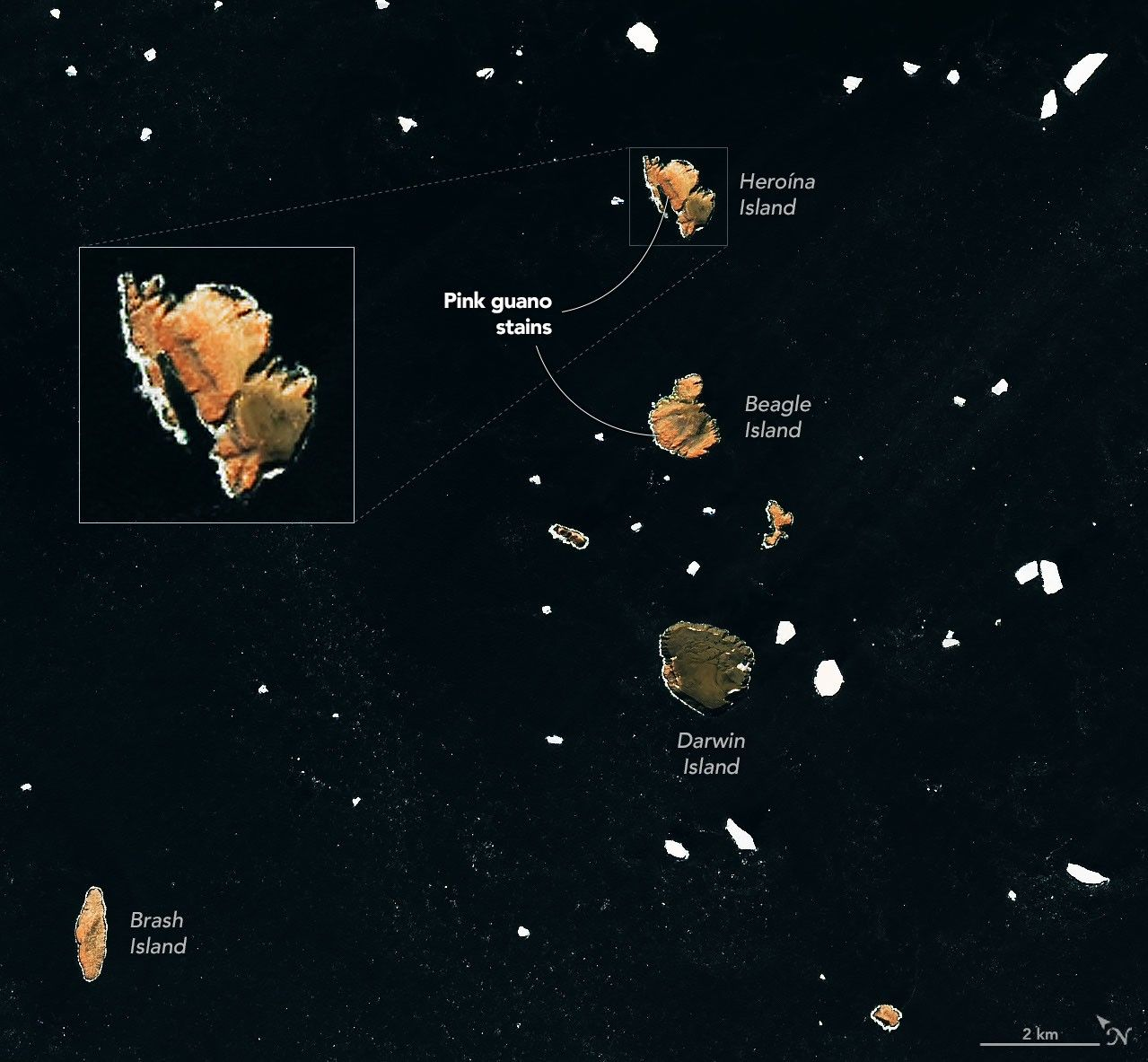
Turns out that the pinkish orangey hues you see from space on Antarctica’s Danger Islands in the image below are due to the large quantities of guano (poop!) produced by the Adélie penguins.
NASA scientists analysed three decades of Landsat images and found that the penguin diets are dependent sea ice conditions. In areas with less sea ice, the penguins have a krill-rich diet and those with more sea ice, they eat more fish (which is healthier for them).
However, the climate is changing and Antarctic sea ice has been recording never-before-seen lows, with even more decreasing sea ice predicted for the future. And, unfortunately, this would mean the penguins need to settle for the less-healthy krill, whose demand is also going to keep increasing.
Until next time,
Aravind.


