


Welcome to a new, belated edition of Earth Observation Essentials, the free biweekly newsletter from TerraWatch covering key highlights from the EO market along with exclusive insights and analysis.
If you would like a more detailed, comprehensive market briefing with exclusive analysis, delivered every week, become a Pro subscriber, or a Premium subscriber, for more deep dives on EO markets, technologies and applications.
📈 EO Market Highlights
Major developments in EO
- NOAA selected 14 companies to compete to deliver commercial weather satellite data under a new 10-year procurement framework with a $2.35B ceiling. The selected firms would provide data include across sensors such as radio occultation, reflectometry, microwave & infrared sounders and even multispectral & SAR imagery.
- Related: Weather intelligence company Tomorrow.io revealed the five instruments planned for its 12-satellite DeepSky weather satellite constellation: microwave sounders, precipitation radars, radio-occultation and reflectometry sensors, plus optical/infrared cameras.
- Google announced the launch of WeatherNext 3, what it claims as the most advanced and accurate global weather model to date (validated by independent benchmarking by weather solution firm Brightband). Interestingly, the new model directly ingests near-real-time satellite imagery integrating fresher observations as weather conditions evolve.
If you are wondering why Google is investing so much into its AI model, the answer is fairly straightforward: weather makes many of its existing products more valuable. Companies already pay Google to use services such as maps and cloud in their own applications.
So, unlike a few weather companies that are also investing in their AI models, Google does not need to monetise this via standalone products, but rather by embedding better weather information into existing infrastructure businesses already use and already pay for.
This is also why it can make the model open while commercialising the infrastructure and applications ecosystem around it.
- Satellogic announced that maritime and energy intelligence provider SynMax will be the exclusive partner for maritime intelligence from its upcoming Merlin constellation, signalling the company's push toward vertically specialised distribution partnerships around dedicated satellite capacity.
- Loft Orbital and UAE-based space investor Marlan Space announced plans for a $1B, 50-satellite EO constellation with optical, radar and other sensors with onboard AI. French AI startup Mistral will provide the AI models while BlackSky was selected to provide high-resolution satellites.
- The US Department of Agriculture announced plans to test the use of satellite imagery and AI to try to improve crop estimates in the country, amid criticism of reliability of federal data.
Satellogic's story has been an interesting one to watch - founded as a company that aimed to remap the world at a lower cost, then it went public via SPAC, then had to contend with sluggish growth - reporting only $13M in revenues in 2024.
But over the past couple of years, the company seemed to have rebounded having won several 6- and 7-figure contracts - including a $30M anchor customer for its upcoming Merlin constellation (1m res. with edge AI).
In last week's Pro newsletter, I analysed Satellogic's recent moves and the new strategy especially how, in a funny way, the company is trying to get back to where it started.
Upgrade to a Pro subscription for just $75 per year to check out the analysis and receive weekly exclusive market briefings.
💡 Insight Bytes
A quick dose of analysis from TerraWatch
The following insight brief is part of the TerraWatch Pro newsletter and included here as a preview for free subscribers. To receive weekly exclusive insights and analysis, become a Pro subscriber at only $75 per year.
Is EO a Strategic Asset, a Commercial Market or a Public Good?
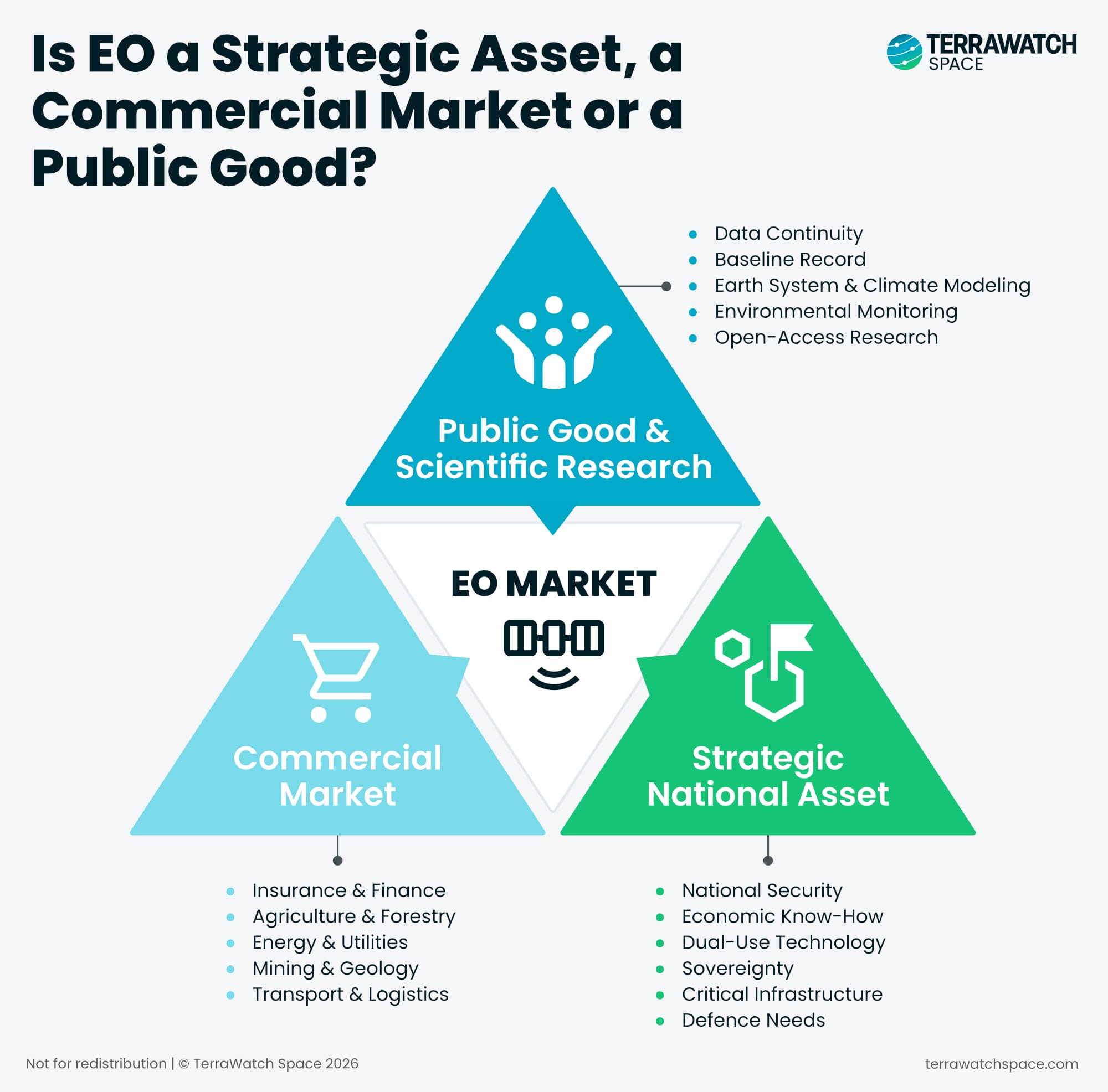
Three forces pull on the EO sector at the same time wanting three somewhat similar, yet seemingly different things – EO capability, EO product and EO record.
- Capability: Governments that want capability they control for security and sovereignty through an industrial base at home.
- Product: Enterprises want a product that uses EO that solves their problem, leading to cost savings, more revenues or enable better decision making.
- Record: Space agencies on the other hand want to launch scientific missions that maintain a calibrated record of observation.
The first customer (government) writes big cheques, signs multi-year contracts and also wants control over distribution and priority access. A company that builds for this customer ends up with revenue concentration and a product it cannot freely sell elsewhere.
The second customer (enterprises) is somewhat the opposite. There are many buyers but the contracts are small with long sales cycles. There is also a demand for finished products that integrate into their workflow rather than just imagery. Serving this requires productization and patience as the revenue arrives slowly.
The third (space agencies) was a traditional customer before outsourcing activities but is starting to take on the role of enabling the EO sector now with data buys. With the evolution of the commercial EO sector, space agencies are figuring out the roles and responsibilities of the private sector in maintaining the continuity and openness of foundational EO, while continuing to advance on the science.
Strategic Asset: National security agencies treat satellite EO as critical infrastructure. The operational mandate is exclusivity, sovereign control, and military-grade security.
Commercial Market: Venture capital treated (at least historically) EO as a B2B market, with high-margin recurring revenue from industries like insurance, agriculture, energy etc.
Public Good: Scientists, society and international bodies treat EO as an open-access public resource, funded by taxpayers for environmental monitoring, disaster response and climate modelling.
Each of the three brings its own test: sovereign capability is measured by whether it exists, especially in times of crisis, a commercial market is measured in revenues, and a public good is measured in access and uptake.
Much of the challenges in EO come from the sector sitting directly in the middle of these conflicting demands – it is essentially a multi-purpose technology searching for an integrated business model that somehow magically works with all three pillars, making it somewhat unique compared to several other technologies.
I think EO is a strategic asset and a commercial market and a public good. The reality is that EO operates (or tries to) on all three fronts simultaneously, creating an operational identity crisis which continues to remain unresolved.
🔍 Recommended Reads
Interesting links to check out
- Turkmenistan has started fixing the super leaks of methane from its ageing oil and gas facilities, and reported as the worst country for methane emissions, thanks to analysis of satellite data.
- The World Meteorological Organization announced that El Niño will intensify into a very strong event in the coming months, with big impacts on rainfall and temperature patterns and associated risks of floods, drought and extreme heat.
- During the International Space Summit held in France, dozens of governments signed two declarations that reaffirmed some principles of EO – one declaration focused on accessibility, openness, integrity and international cooperation of space-based scientific data and the second on the Copernicus calling it a "global public good whose continuity is essential."
If you would like a deep-dive on what these declarations mean for EO open data policy, global EO governance and whether they change anything, check out my recently published essay on this subject.
- NASA and ESA are using Sentinel-6 sea-level measurements to estimate ocean heat content, helping forecasters assess how quickly hurricanes could intensify. as well as tracking the ongoing El Niño phenomenon by measuring sea-surface height, waves, winds and atmospheric conditions.
🛰️ Scene from Space
One visual leveraging EO
Welcoming Fall in the Northern Hemisphere
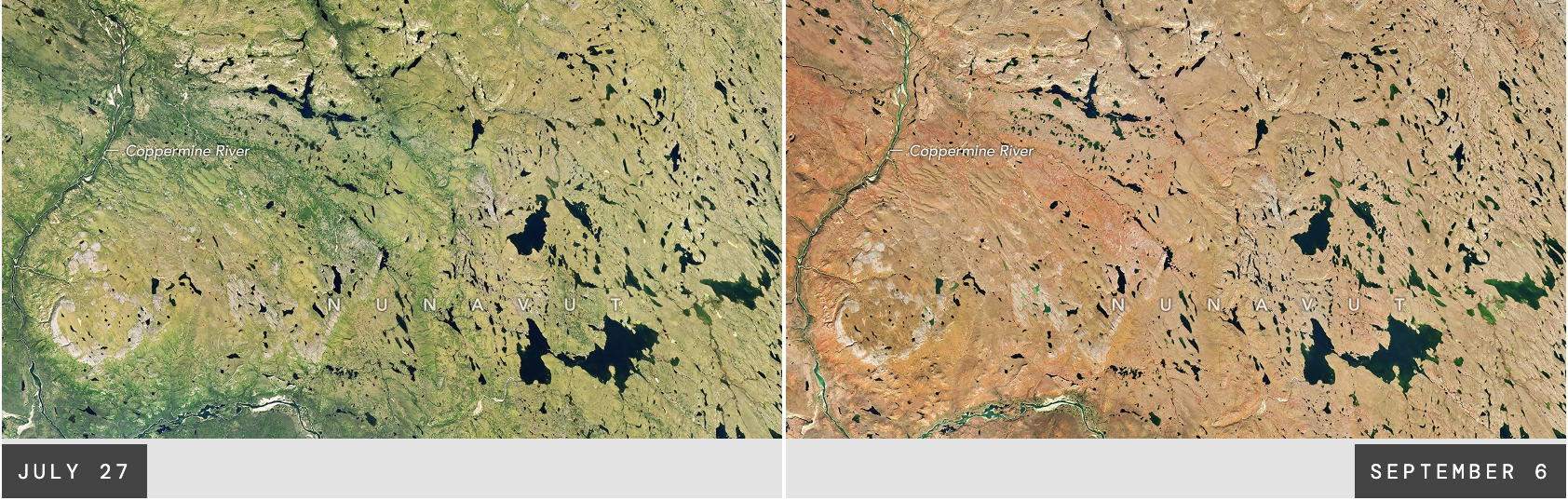
Given the supposedly* spherical shape of the Earth and its tilt, fall comes early in far northern Canada. The images below from Landsat 9 show the difference in vegetation colours and the change in the region in just a 10-day period.
According to analysis from NASA and South Dakota State University, foliage in the region changes in early September and peaks in mid-month – making this part of Canada likely the first place on the North American continent to change color. Happy fall/autumn, everyone!
*Just kidding, I am not a flat-earther!
Until next time,
Aravind.


