


Welcome to a new edition of ‘Last Week in Earth Observation’, containing a summary of major developments in EO from the last week and some exclusive analysis and insights from TerraWatch.
Four Curated Things
Major developments in EO from the past week
1. Contractual Stuff: Funding, Contracts and Deals 💰
Funding
- SARsatX, a Saudi and UAE-based SAR satellite manufacturer raised early-stage funding;
- Treefera, an EO-based monitoring solution for nature-based solutions raised $12M in Series A funding;
Contracts
- Weather intelligence firm Tomorrow.io won a $10.2M contract from the DoD to build and launch two satellites equipped with microwave sounders;
- Polish EO payload manufacturer Scanway Space signed a contract with South Korean satellite firm Nara Space to supply an infrared instrument for detecting methane plumes;
- The UK Space Agency has awarded £9M in funding for early-stage research into the development of satellite instruments for monitoring climate.
2. Strategic Stuff: Partnerships and Announcements 📈
Announcements
Maxar launched ClimateDesk, a platform to translate climate data into actionable information for enterprises;
Thermal imaging satellite firm SatVu has booked launches for its second and third spacecraft in 2025 after its first satellite failed late last year;
Seraphim Space announced the list of startups joining its accelerator programme, which includes 3 EO firms:
Energy analytics provider CarbonLaces, flood analytics provider SaferPlaces and EO calibration service provider Four Resolutions.
Partnerships
- EarthDaily Agro, the subsidiary of EarthDaily Analytics, announced a strategic partnership with Norwegian ag-tech startup DigiFarm;
- German EO startup Marble Imaging is partnering with Reflex Aerospace to build and launch its high-resolution satellite constellation;
- Planet, Salesforce, sustainability consulting firm ERM and biodiversity monitoring solution NatureMetrics announced a new initiative to help companies tackle urgent biodiversity challenges.
3. Interesting Stuff: More News 🗞️
- India may have lost close to 5.8 million full-grown trees on agricultural lands from 2019 to 2022, according to a new study based on EO data;
- Rocket Lab will be launching NASA’s PREFIRE mission aimed at measuring radiant heat emitted at the poles, which is useful for climate science;
- Spire reported $25.7M in Q1 revenue, below projected guidance of $27 million and $29 million for the quarter, but 6% higher compared to last year;
- More than 60% of the world's coral reefs may have bleached in the past year, according to NOAA;
- The Central Weather Administration of China and the Taiwan Space Agency signed an MoU to enhance meteorological observations.
4. Click-Worthy Stuff: Check These Out 🔗
- This paper that summarises the importance of seasonal weather forecasts, enabled by satellite data, on financial markets;
- The EU’s EO Strategic Research and Innovation Agenda, that provides a framework for R&D activities related to the Copernicus programme;
- This paper that reviews the accuracy of existing EO-based land cover maps in Sub-Saharan Africa;
- This article that discusses how NASA is using satellite data to forecast the risk of cholera outbreaks.

EO Summit: Full Programme
EO Summit is filled with presentations on a variety of commercial use cases from EO users across different sectors along with the exciting EO solutions that will be showcased in the 4 industry tracks. Register before it is too late!
💸 Get 10% off with the code 'EOSUMMIT_SALE' until May 26! 💸
One Discussion Point
Exclusive analysis and insights from TerraWatch
5. Impact of Edge Computing on the EO Value Chain
What impact can edge computing (or on-board processing) have on the EO industry, and more specifically, how does it affect the EO value chain?
If you have read anything from TerraWatch before, you know that I segment the EO Operating Stack into 5 segments: Data, Platform, Analytics, Insights and Applications. Edge computing might have some interesting dynamics on the Platform layer, but its impact on the Analytics layer is perhaps more fascinating.
As a reminder, the Analytics layer is the part of the EO value chain, where data is converted into useful information, sometimes by integrating other sources of data. However, note that the Analytics layer does not inform, it only translates. You might not be able to make direct decisions with Analytics, as you might need to contextualise the information. Some examples of Analytics are cloud detection, vessel identification, building detection, crop classification etc. As you see, Analytics is all about converting imagery on pixels into some information, but it is not an actionable insight.
And that is what edge computing brings to the table - the ability to process data onboard the satellite, as it is being taken, in order to convert this data into some form of useful information. Note that edge computing might not necessarily provide actionable Insights, nor can it become a usable Application. My thesis is that edge computing helps move the Analytics layer closer to the orbit, but not completely away from the ground, as the figure represents below.

As an example, edge computing may enable the detection of clouds in orbit, but might not succeed in detecting all clouds in the image from the start. It may enable the detection of vessels in the sea, but may not provide a 100 per cent accuracy to begin with. And, the power of edge computing may not be enough to detect objects that are inherently harder to detect scalably (like the different types of trees), especially objects that require a lot of training data. The differences between traditional AI (on the ground) vs. edge AI (in orbit) might have limitations on how much information it can derive. At least as long as we successfully build data centers in space, where training data can be stored.
So, what edge computing really does to the EO Operating Stack is it literally shakes things up a bit - moving the Analytics layer closer to orbit. At least for starters, some simple forms of Analytics like cloud detection and vessel detection can be “outsourced” to be performed on-orbit, while the more complex forms of Analytics such as building detection and crop identification might be harder to execute with limited training data available onboard the satellite.
For more on edge computing, check out the exclusive deep dive on the topic, which is accessible to paid subscribers. Not a subscriber? You can do it now!
Scene from Space
One visual leveraging EO
6. Severe Flooding in Brazil
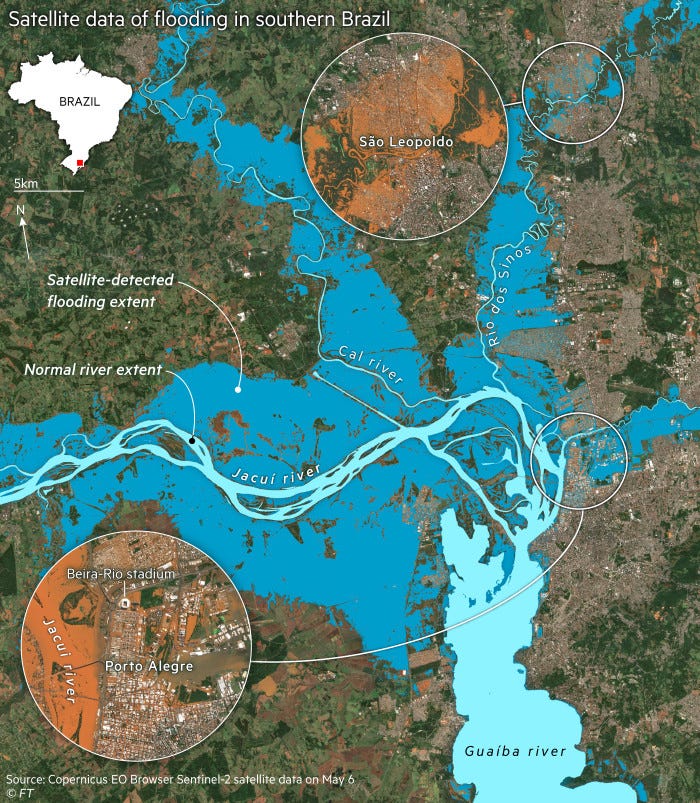
Rio Grande do Sul, a state in southern Brazil is experiencing an environmental and humanitarian disaster. Persistent heavy rains for a third consecutive week have led to severe flooding in southern Brazil killing at least 150 and displacing over 600,000 people, with economists estimating the economic damage done to be about $2bn. The following image from the FT shows the extent of the flooding.
Until next time,
Aravind.


